

As Zimbabwe braces for a possible Super El Niño drought, this article offers 7 Bible verses from Habakkuk, Elijah, Joseph, Exodus, Ruth, Isaiah, and 2 Chronicles encouraging hope, wise preparation, daily trust, generosity, and prayer. It reminds readers that faith and practical action can coexist, and God remains present through dry seasons.
7 Bible Verses to Hold Onto When the Future Feels Uncertain
Zimbabwe is bracing for a possible “Super El Niño” this coming season, dry fields, empty dams, and hard choices ahead. But drought is nothing new to Scripture. Here are 7 verses that meet us right where the ground is cracking
1. Choose Hope When Things Look Empty
Habakkuk 3:17–18 (NIV)
“Though the fig tree does not bud… yet I will rejoice in the Lord.”
Habakkuk faced failed crops and empty fields, yet he chose to trust God. Faith doesn’t mean pretending everything is fine. It means holding onto hope even when things aren’t.
2. God Can Provide Unexpectedly
1 Kings 17:4 (NIV)
“I have directed the ravens to feed you there.”
During a drought, God provided for Elijah through ravens. His provision didn’t come in the way Elijah might have expected.
Prepare wisely, but remember that God can provide through unexpected people and opportunities.
3. Faith Doesn’t Cancel Preparation
Genesis 41:34–36 (NIV)
“Take a fifth of the harvest… to be held in reserve.”
Joseph prepared for famine before it arrived. His story reminds us that trusting God and planning ahead aren’t opposites.
Save where you can. Conserve resources. Plan wisely. Faith can be practical.
4. Take It One Day at a Time
Exodus 16:4 (NIV)
“The people are to go out each day and gather enough for that day.”
God taught Israel to depend on Him daily.
It’s easy to panic about what the next few months might bring. But don’t let tomorrow’s “what if?” steal today’s peace.
Do what you can today and trust God with tomorrow.
5. A Hard Season Isn’t the End
Ruth 1:1, 6 (NIV)
Ruth’s story began with famine, loss and displacement. Yet that wasn’t the end of her story.
Sometimes we can’t see beyond the difficult season we’re in. But God can still bring new beginnings from hard chapters.
6. Don’t Forget Others When Resources Are Tight
Isaiah 58:10–11 (NIV)
“If you spend yourselves on behalf of the hungry… you will be like a well-watered garden.”
Dry seasons can create a “look out for yourself” mindset. Scripture challenges us to care for those who have even less.
Share what you can. Check on someone. Support your community.
7. Turn to God in Uncertain Times
2 Chronicles 7:14 (NIV)
“If my people… will humble themselves and pray and seek my face…”
When the future feels uncertain, prayer should be part of our response.
Let’s pray for rain, farmers, families, vulnerable communities and wisdom for those making decisions that affect the nation.
The Ground May Be Dry, But God Isn’t Gone
Zimbabwe may face a difficult season, but drought doesn’t mean God has disappeared.
Prepare. Pray. Help one another. Keep trusting.
Because deep faith doesn’t mean pretending the season isn’t dry. It means trusting God while walking through it.
The ground may be dry. The future may be uncertain. But God is still God.
Who wrote the book of Ruth?
Jewish tradition credits Samuel as the author of Ruth, writing between roughly 1010–990 BC — after David became king but before Solomon’s reign. Some scholars, however, argue a post-exilic author penned it centuries later as a theological statement about welcoming outsiders, using David’s lineage to lend the story credibility.
Who Wrote the Bible? — Series 4
A love story across enemy lines — and the great-grandmother of a king. Ruth is not playing around.
Wait — who is Ruth?
Before we get into authorship, let’s set the scene. Ruth is a Moabite woman who ends up marrying an Israelite man. After he dies, she refuses to leave his mother Naomi and travels with her back to Israel. There she meets Boaz — and the rest, as they say, is history. Literally.
Ruth’s place in the family tree
Ruth + Boaz → Obed → Jesse → King David → … → Jesus
That family tree is not a small detail. Ruth — a foreign woman from a nation Israel had serious beef with — ends up in the direct bloodline of King David, and by extension, Jesus. The book is only four chapters long, but its reach across the rest of the Bible is enormous.
Why was Ruth and Boaz such a big deal?
Because Moab and Israel did not get along. At all. The origin story of Moab is genuinely one of the most dramatic in the Bible — after the destruction of Sodom and Gomorrah, Lot’s daughters got their father drunk and, well, nine months later the Moabite nation was born. The relationship between Israel and Moab never really recovered from that origin story. There was conflict, exclusion, and centuries of side-eye between the two peoples. Serious beef.
So Ruth — a Moabite woman — choosing Israel, and an Israelite man choosing her back? That would be trending content by today’s standards. It’s a story about loyalty, love, and crossing boundaries that society said shouldn’t be crossed.
The Hebrew word for Ruth’s loyalty to Naomi — “hesed” — is the same word used for God’s faithful love throughout the Old Testament.
So who wrote it?
Jewish tradition points to Samuel — the same figure we discussed in the Judges instalment. The internal clues from the text are what point us there:
| Ruth 1:1 | Ruth 4:17-22 |
| The book opens “in the days when the judges ruled” — past tense. The author is looking back at the judge era, meaning they’re writing after it ended, i.e. after kings came on the scene around 1050 BC. Written after the monarchy began. | The book ends with a genealogy that goes all the way to King David — but stops there. Solomon, David’s son, isn’t mentioned. Since Solomon’s reign began around 970 BC, this places the writing between roughly 1010 and 990 BC. Written after David became king, before Solomon’s reign. |
That window lines up neatly with Samuel’s lifetime. He anointed David as king, he was active right at the close of the judge era, and he had every reason to document a story that legitimised David’s lineage — including a Moabite great-grandmother who embodied the kind of faithfulness Samuel valued.
But not everyone buys it
Some scholars push the authorship much later — to the post-exilic period, around the late 6th or 5th century BC. Their argument hinges on a bigger question: is Ruth a historical account, or a carefully crafted story?
| Samuel wrote it (~1010–990 BC) | Post-exilic author (~500s BC) |
| Ruth is real history — David was real, so his family history is real. Samuel recorded it close to the events. | Ruth is a composed story, written to make a theological point about welcoming outsiders, using the David connection for credibility. |
The post-exilic theory argues the book was written as a counter-narrative to strict “Israel only” policies of the era — a way of saying, through story, that even King David had foreign blood. It’s a compelling read. But it requires treating the book as fiction, which not everyone is willing to do.
So — real history or compelling story?
We know King David existed. We know Moab existed. The real question is whether Ruth did too — and whether her story was preserved because it happened, or invented because it needed to be told.
Either way, a cross-cultural love story that ends up in the bloodline of the most important figure in the New Testament is worth paying attention to — regardless of who put it on paper.
History or story?
Does a Moabite-Israelite love story sound too good to be true, or exactly the kind of thing that was bound to happen?
@biblesocietyofzimbabwe A forbidden love story, ancient political beef, and a family tree that changed history forever. Welcome to Part 4 of Who Wrote the Bible? 🧵👇🏾 If you think the Bible is just a list of rules, you haven’t read the Book of Ruth. It’s only four chapters long, but it packs more drama than a reality TV finale. #WhoWroteTheBible #BiblicalHistory #BookOfRuth #AncientHistory #TheologyMatters
♬ original sound – Bible Society of Zimbabwe
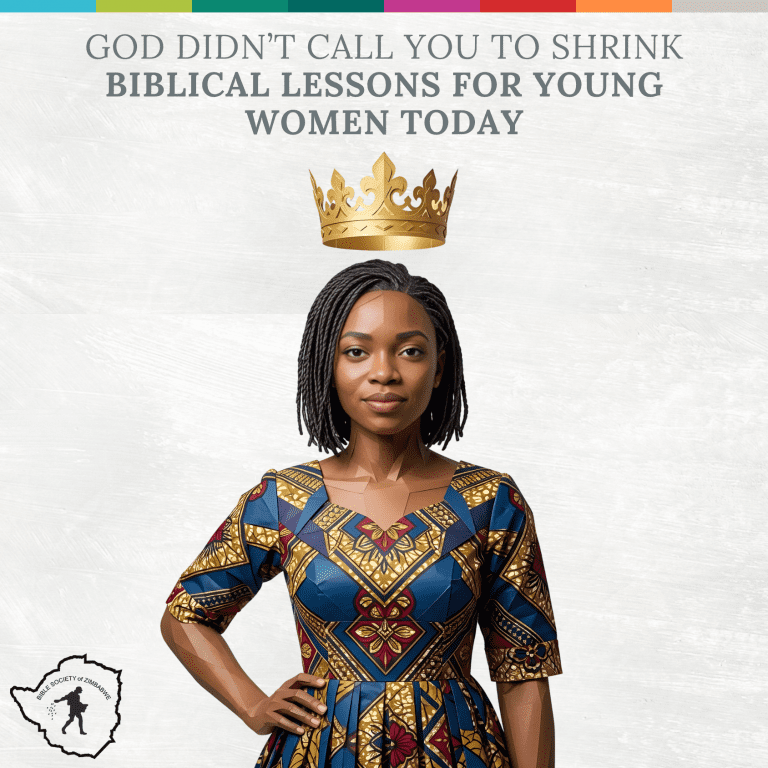
International Women’s Month Reflection — Rising With Courage, Faith, and Purpose
In a world filled with expectations, comparisons, and constant pressure to fit into certain boxes, many young women quietly learn to shrink themselves. Some shrink their voices to avoid conflict. Others shrink their dreams because they fear rejection. Many shrink their confidence because society measures worth by appearance, relationship status, or social media approval.
But Scripture tells a different story.
God never designed women to live small, hidden lives shaped by fear or insecurity. Throughout the Bible, He consistently called women to step forward, speak boldly, lead courageously, and live purposefully.
As we celebrate International Women’s Month, here are seven powerful biblical lessons reminding young women that God did not call them to shrink, He called them to rise.
1. You Are Called — Not Just Included
Jeremiah 29:11
“For I know the plans I have for you,” declares the Lord, “plans to prosper you and not to harm you, plans to give you hope and a future.”
Many young women grow up feeling like they must wait to be chosen, chosen for opportunities, relationships, leadership roles, or recognition.
But God does not treat women as afterthoughts or spectators.
Before anyone noticed you, God already designed a future filled with purpose. Your dreams, talents, compassion, intelligence, and passions are not random. They are part of His plan.
Sometimes shrinking happens quietly. You stop applying for opportunities because you doubt yourself. You silence ideas because you assume others know better. You delay obedience because fear feels safer.
God’s promise reminds you that your future is intentional.
Lesson: You are not just included in God’s story, you are called to actively shape it.
2. God Uses Ordinary Women to Do Extraordinary Things
Luke 1:38
“I am the Lord’s servant,” Mary answered. “May your word to me be fulfilled.” Then the angel left her.
When God chose Mary, mother of Jesus, she was not a queen, scholar, or public leader. She was a young woman from a small town with no social influence or power.
Yet God entrusted her with carrying the greatest promise in history.
Mary faced misunderstanding, fear, and uncertainty. Saying yes to God meant risking reputation and comfort. Still, she chose obedience over fear.
You might believe you must become “perfect,” successful, or fully confident before God can use you. But Mary’s story reminds us that God often begins with willingness, not qualifications.
You do not have to wait until you feel ready to step into purpose.
Lesson: God does extraordinary work through ordinary women who say yes to Him.
3. Courage Begins When Fear Ends
Esther 4:14
“And who knows but that you have come to your royal position for such a time as this?”
Queen Esther faced a life-threatening decision. Speaking up could cost her everything, yet silence would cost others their lives.
Today as a young woman, you face different battles: standing against injustice, resisting peer pressure, choosing integrity in relationships, or defending their faith.
Courage does not mean fear disappears. It means choosing obedience despite fear.
Lesson: The moment you feel most afraid may be the moment God wants you to stand.
4. Your Past Does Not Cancel Your Future
John 4:28–29
“Then, leaving her water jar, the woman went back to the town and said to the people, ‘Come, see a man who told me everything I ever did.’”
The Samaritan woman met Jesus carrying shame and rejection. Society avoided her, but Jesus spoke to her publicly and respectfully.
Her encounter turned her into one of the first evangelists in her community.
You might be led to believe that mistakes define you. Social media rarely shows healing journeys, only polished outcomes.
Jesus shows that restoration is stronger than reputation.
Lesson: God can turn your story into someone else’s breakthrough.
5. Faithfulness Builds Influence
Ruth 1:16
“Where you go I will go, and where you stay I will stay.”
When life collapsed around her, Ruth chose loyalty and faith.
She was a foreigner, a widow, and vulnerable, yet God used her faithfulness to place her in the lineage of Jesus Christ.
You often feel pressured to rush success or recognition. Ruth shows that quiet obedience opens extraordinary doors.
Lesson: You don’t need shortcuts when God is directing your steps.
6. Jesus Defended Women Others Judged
John 8:10–11
“Jesus straightened up and asked her, ‘Woman, where are they? Has no one condemned you?’”
When religious leaders tried to shame a woman publicly, Jesus protected her dignity and offered restoration.
In today’s culture, as a woman, you are often judged harshly, online and offline.
Jesus’ response reminds you that grace is stronger than condemnation.
Lesson: God calls you forward, not backward into shame.
7. Confidence Comes From God’s Spirit
2 Timothy 1:7
“For the Spirit God gave us does not make us timid, but gives us power, love and self-discipline.”
As a young woman, you might be battling anxiety, fear of failure, or fear of judgment.
God’s Spirit produces courage, wisdom, and self-control.
Confidence rooted in God does not become arrogance, it becomes service, compassion, and bold faith.
Lesson: You were not created to live timidly.
Final Reflection: Rise Without Apology
International Women’s Month reminds us that empowerment is not about competing with others, it is about becoming who God created you to be.
Like Deborah, you can lead.
Like Esther, you can speak courageously.
Like Ruth, you can build legacy through faithfulness.
Like the Samaritan woman, your story can inspire change.
You do not need to shrink your dreams, your faith, your gifts, or your voice.
God didn’t call you to disappear, He called you to rise.
1: The Strength of a Mother
- Reading: Proverbs 31:25-31 She watches over the affairs of her household and does not eat the bread of idleness.
The Bible honors mothers who are strong, wise, and diligent. A Proverbs 31 woman is described as clothed with strength and dignity, speaking with wisdom, and watching over her household with care. Her children rise to call her blessed, and her works bring her praise. This passage celebrates the nurturing spirit and resilience that define motherhood.
- Reflection:
How can you embody strength and dignity in your journey as a mother or as a mentor to others? Pray for wisdom and grace to impact your family positively.
2: A Mother’s Faith
- Reading: 2 Timothy 1:3-7 I am reminded of your sincere faith, which first lived in your grandmother Lois and in your mother Eunice and, I am persuaded, now lives in you also.
Timothy’s strong faith was nurtured by two remarkable women—his mother, Eunice, and his grandmother, Lois. Their sincere belief shaped his spiritual foundation, enabling him to become a respected leader. This story reminds us of the powerful influence that a mother’s faith can have on her children, passing down a legacy of devotion and integrity.
- Reflection:
Think about the spiritual heritage you are creating for your children. Pray for your faith to be steadfast and inspiring, impacting future generations.
3: God’s Comfort Like a Mother’s Love
- Reading: Isaiah 66:13 As a mother comforts her child, so will I comfort you; and you will be comforted over Jerusalem.
In a beautiful comparison, God promises to comfort His people just as a mother comforts her child. This image conveys warmth, safety, and reassurance. When life brings hardships, God’s nurturing presence surrounds us, reminding us that we are never alone. Mothers often reflect this aspect of God’s character, offering solace and encouragement through life’s challenges.
- Reflection:
Have you experienced God’s comforting presence recently? Take a moment to thank Him for His unwavering love and pray for the ability to extend that same comfort to your family.
4: A Mother’s Prayer
- Reading: 1 Samuel 1:9-20 And she made a vow, saying, “Lord Almighty, if you will only look on your servant’s misery and remember me, and not forget your servant but give her a son, then I will give him to the Lord for all the days of his life, and no razor will ever be used on his head.
Hannah’s story is a powerful reminder of the importance of prayer and surrender. Despite her years of childlessness and ridicule, she poured out her heart to God. When God blessed her with Samuel, she faithfully kept her vow and dedicated him to the Lord’s service. Hannah’s faith teaches us that persistent prayer and trust can turn sorrow into joy.
- Reflection:
What are you earnestly praying for as a mother? Bring your deepest desires to God, trusting Him to work in ways that surpass your understanding.
5: Waiting on God for a Child
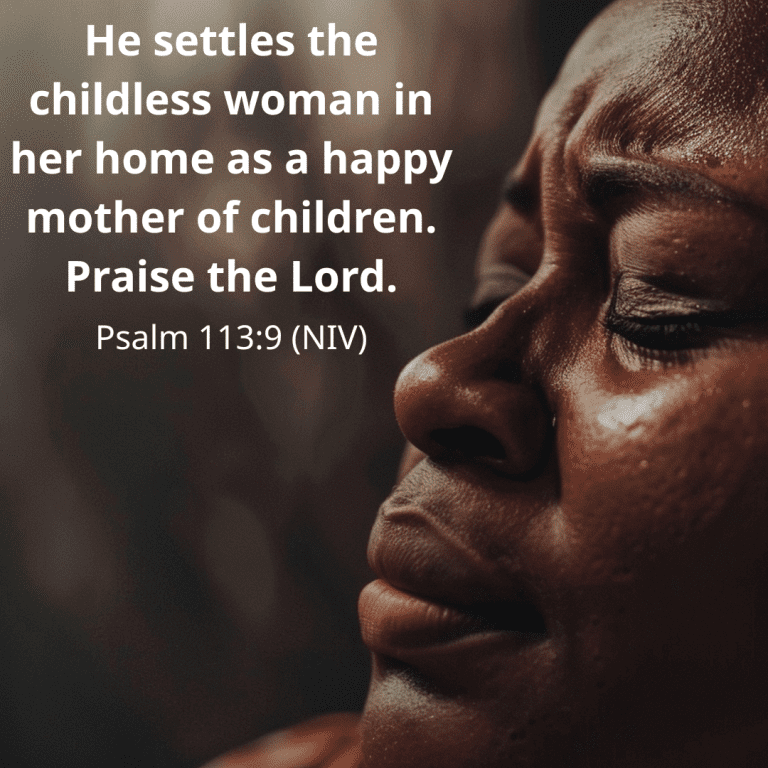
- Reading: Psalm 113:9 He settles the childless woman in her home as a happy mother of children. Praise the Lord.
This verse is a promise of hope to those longing for children: “He settles the childless woman in her home as a happy mother of children.” God sees the silent prayers of women waiting for the fruit of the womb, and His compassion reaches those who feel forgotten. Like Sarah, Hannah, and Elizabeth, many women in the Bible experienced long periods of waiting, but God’s timing brought joy.
- Reflection:
If you or someone you know is waiting for a child, take comfort in God’s faithfulness. Pray for peace, strength, and hope, believing that God’s plans are good and His timing is perfect.
6: A Mother’s Legacy of Love
- Reading: Ruth 1:16-18 Don’t urge me to leave you or to turn back from you. Where you go I will go, and where you stay I will stay. Your people will be my people and your God my God.
Naomi’s relationship with Ruth exemplifies love and loyalty beyond blood relations. Ruth’s decision to stay with Naomi despite personal loss shows that family bonds can be forged through love, commitment, and shared faith. Naomi’s guidance and Ruth’s dedication eventually led to God’s blessing in their lives.
- Reflection:
Consider the people God has placed in your life who feel like family. How can you nurture and support them with love and encouragement?
7: A Mother’s Blessing
- Reading: Luke 1:46-55 For the Mighty One has done great things for me, holy is his name.
Mary’s song of praise reflects a mother’s joy and humble gratitude. Despite the uncertainties of her calling, she glorified God for choosing her to bear the Savior. Her willingness to embrace God’s plan, even when it seemed daunting, teaches us to rejoice in the blessings we receive while remaining faithful through challenges.
- Reflection:
Take time to praise God for the gift of motherhood and the privilege of shaping lives. Pray for the grace to guide your children in love, faith, and wisdom.
The love story of Ruth and Boaz is one of the most heartwarming narratives in the Bible. It highlights loyalty, kindness, and the providence of God. Below is a seven-part exploration of their story, showcasing key moments and lessons we can learn.
1. Ruth’s Loyal Love for Naomi
Bible Verse: “But Ruth replied, ‘Don’t urge me to leave you or to turn back from you. Where you go, I will go, and where you stay, I will stay. Your people will be my people and your God my God.'” (Ruth 1:16)
The story begins with Ruth’s decision to stay with her mother-in-law, Naomi, after the loss of their husbands. Despite being a Moabite with no obligation to remain, Ruth chooses loyalty and selfless love over personal comfort. Her declaration of commitment is a profound example of love rooted in devotion and faith.
Lesson: True love often involves sacrifice and putting others’ needs before your own.
2. Ruth’s Humility and Hard Work
Bible Verse: “Let me go to the fields and pick up the leftover grain behind anyone in whose eyes I find favor.” (Ruth 2:2)
Arriving in Bethlehem, Ruth immediately seeks ways to provide for herself and Naomi. She humbly works in the fields, gleaning leftover grain, which was allowed under the law for the poor (Leviticus 19:9-10). Her actions reflect love expressed through diligence and service.
Lesson: Love is not just about words but is demonstrated through actions of care and responsibility.
3. Boaz’s Kindness Toward Ruth
Bible Verse: “The Lord bless you, my daughter. This kindness is greater than that which you showed earlier… You have not run after the younger men, whether rich or poor.” (Ruth 3:10)
Boaz, a wealthy landowner and relative of Naomi, notices Ruth’s character and dedication. He treats her with kindness, ensuring she has more than enough grain and protection while working in his fields. Boaz’s actions are motivated by compassion and respect for Ruth’s integrity.
Lesson: Love involves recognizing and honoring the worth of others, especially their character and efforts.
4. Ruth’s Bold Request for Redemption
Bible Verse: “Spread the corner of your garment over me, since you are a guardian-redeemer of our family.” (Ruth 3:9)
Following Naomi’s guidance, Ruth approaches Boaz at night, asking him to act as her kinsman-redeemer. This was not a romantic gesture in the modern sense but a cultural and legal request for protection and provision. Ruth’s boldness reflects her trust in both Boaz and God’s plan.
Lesson: Love sometimes requires stepping out in faith and making courageous decisions.
5. Boaz’s Integrity and Commitment
Bible Verse: “I will do for you all you ask. All the people of my town know that you are a woman of noble character.” (Ruth 3:11)
Boaz agrees to Ruth’s request but ensures the proper legal steps are taken first. He respects the traditions and laws of Israel, seeking permission from a closer relative before redeeming Ruth. His actions show his integrity and willingness to do things the right way.
Lesson: Love is honorable and seeks to uphold righteousness in all circumstances.
6. The Marriage of Ruth and Boaz
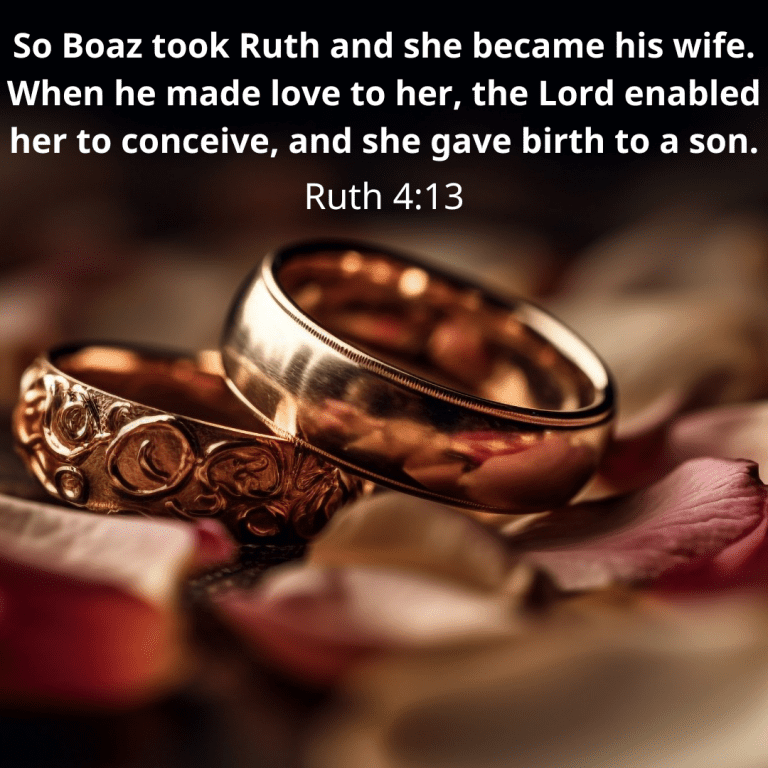
Bible Verse: “So Boaz took Ruth and she became his wife. When he made love to her, the Lord enabled her to conceive, and she gave birth to a son.” (Ruth 4:13)
Boaz redeems Ruth and marries her, fulfilling his role as her kinsman-redeemer. Their union is not only a picture of love between two people but also a reflection of God’s faithfulness in providing for His people.
Lesson: God honors love that is rooted in obedience, faithfulness, and His divine plan.
7. God’s Providential Love Through Their Lineage
Bible Verse: “Then Naomi took the child in her arms and cared for him. The women living there said, ‘Naomi has a son!’ And they named him Obed. He was the father of Jesse, the father of David.” (Ruth 4:16-17)
Ruth and Boaz’s love story is woven into God’s grand plan. Their son, Obed, becomes the grandfather of King David, placing them in the lineage of Jesus Christ (Matthew 1:5). This demonstrates how God uses love and faithfulness to fulfill His promises.
Lesson: Love that honors God has eternal significance, impacting generations to come.
Conclusion
The story of Ruth and Boaz is more than a romance—it’s a testament to God’s providence and the power of love rooted in loyalty, humility, and faith. Their story encourages us to trust God’s plan, love selflessly, and honor Him in all our relationships.
Let this example inspire us to live with the same devotion and integrity, trusting that God is working behind the scenes to bring about His perfect plan for our lives.

As we commemorate Workers’ Day, we explore the Bible and learn from its characters who show us how to work hard, stay dedicated, and keep going even when things are tough.
Consider Joseph, whose story in Genesis records his journey from a lowly servant to a position of great influence in Egypt. Despite facing betrayal, false accusations, and years of imprisonment, Joseph remained strong in his faith and diligence. His undying commitment to his work, even in the face of bad situations, led to his promotion and the preservation of many lives during a time of famine. (Genesis 37 – 41)
Then there’s Ruth, a woman of remarkable loyalty and perseverance. Despite her status as a foreigner and widow, Ruth tirelessly worked in the fields to provide for herself and her mother-in-law, Naomi. Through her diligent labor and unwavering faithfulness, Ruth caught the attention of Boaz, who later became her husband. Her story reminds us that no act of labor, no matter how small, goes unnoticed by the One who sees and rewards our efforts. (Ruth 2 -8)
Let’s not forget about Nehemiah, whose passion for rebuilding the walls of Jerusalem serves as a testament to the transformative power of vision, determination, and teamwork. Despite facing opposition and tough challenges, Nehemiah organised the people to work tirelessly, each contributing their skills and resources to accomplish a task in record time. His leadership and unwavering faith in God’s provision inspire us to pursue our work with purpose and unity. (Nehemia 2 – 4)
And of course, we cannot overlook the example of Jesus Christ himself, who, during his earthly ministry, demonstrated humility, servanthood, and sacrificial love. Whether he was healing the sick, feeding the hungry, or teaching the crowds, Jesus embodied the essence of true labor, selflessly serving others for the glory of God. (Matthew, Mark, Luke and John)
As you reflect on Workers’ Day, may you draw inspiration from these biblical characters and their examples of dedication, resilience, and service. May their stories ignite a renewed passion for your work, knowing that your labor, when done with excellence and integrity, has the power to impact lives, glorify God, and usher in positive change in our world. Happy Workers’ Day!
Who Wrote the Bible? - Ruth, Explained
Jewish tradition credits Samuel as the author of Ruth, writing between roughly 1010–990 BC — after David became king but before Solomon's reign. Some scholars, however, argue a post-exilic author penned it centuries later as a theological statement about welcoming outsiders, using David's lineage to lend the story credibility.
Jewish tradition credits Samuel as the author of Ruth, writing between roughly 1010–990 BC — after David became king but before Solomon's reign. Some scholars, however, argue a post-exilic author penned it centuries later as a theological statement about welcoming outsiders, using David's lineage to lend the story credibility.
God Didn’t Call You to Shrink: Biblical Lessons for Young Women Today
In a world filled with expectations, comparisons, and constant pressure to fit into certain boxes, many young women quietly learn to shrink themselves. Some shrink their voices to avoid conflict. Others shrink their dreams because they fear rejection. Many shrink their confidence because society measures worth by appearance, relationship status, or social media approval.
7 Powerful Bible Readings for Moms: Strength, Comfort, and Prayer
This verse is a promise of hope to those longing for children: "He settles the childless woman in her home as a happy mother of children." God sees the silent prayers of women waiting for the fruit of the womb, and His compassion reaches those who feel forgotten. Like Sarah, Hannah, and Elizabeth, many women in the Bible experienced long periods of waiting, but God’s timing brought joy.
Ruth and Boaz: A Love Story About Loyalty, Faith, and God's Plan
The story of Ruth and Boaz is more than a romance—it’s a testament to God’s providence and the power of love rooted in loyalty, humility, and faith. Their story encourages us to trust God’s plan, love selflessly, and honor Him in all our relationships.
In a world filled with expectations, comparisons, and constant pressure to fit into certain boxes, many young women quietly learn to shrink themselves. Some shrink their voices to avoid conflict. Others shrink their dreams because they fear rejection. Many shrink their confidence because society measures worth by appearance, relationship status, or social media approval.
This verse is a promise of hope to those longing for children: "He settles the childless woman in her home as a happy mother of children." God sees the silent prayers of women waiting for the fruit of the womb, and His compassion reaches those who feel forgotten. Like Sarah, Hannah, and Elizabeth, many women in the Bible experienced long periods of waiting, but God’s timing brought joy.
The story of Ruth and Boaz is more than a romance—it’s a testament to God’s providence and the power of love rooted in loyalty, humility, and faith. Their story encourages us to trust God’s plan, love selflessly, and honor Him in all our relationships.