
Theme verse: “We hear them declaring the wonders of God in our own tongues!” – Acts 2:11
Picture this: you’re at a massive global festival — music blasting, people in colorful outfits, food stalls with smells from every country. You hear bits of conversation all around you — French, Korean, Shona, Spanish — but none of it really lands with you because it’s not your language. Then suddenly, over the noise, you hear someone speaking your exact dialect — telling a story that feels like it was written for you. Instantly, you feel seen, understood, and connected.
That’s what happened on the Day of Pentecost in Acts 2. The Holy Spirit didn’t just drop a universal language from the sky, He gave the disciples the ability to speak the heart languages of everyone there. It was the first miraculous translation of the Gospel, and it set the tone for how God’s Word would travel through history: personal, accessible, and in every language under heaven.
Here are 7 Bible verses showing how God values every language — and why translation is still His heartbeat today.
1. Acts 2:4 – “All of them were filled with the Holy Spirit and began to speak in other tongues as the Spirit enabled them.”
This moment wasn’t about showing off supernatural skills; it was about connection. Imagine a livestream where the subtitles instantly appear in every viewer’s language without a glitch. That’s the Pentecost miracle. God could have picked one “holy” language and told the world to learn it, but instead, He said, “I’ll come to you where you are.” He knew that the fastest way to someone’s heart is to speak in words they’ve known since childhood — the ones their grandmother used when telling bedtime stories, the ones they use when they cry or pray.
2. Acts 2:11 – “We hear them declaring the wonders of God in our own tongues!”
The crowd didn’t just hear “religious talk.” They heard the wonders of God — in words they didn’t have to translate in their heads. It’s the difference between watching a movie dubbed in your language versus struggling through with broken subtitles. When the message comes in your mother tongue, it feels like it was crafted for you. That day, God wasn’t just talking to people — He was talking with them, in the very vocabulary that shaped their identity.
3. Revelation 7:9 – *”…from every nation, tribe, people and language, standing before the throne…” *
Heaven will not be a one-language zone. It will be the most diverse, colorful gathering ever — every accent, every rhythm, every dialect praising the same God. Translation work today is like a sneak preview of that day. Every time a new Bible translation is completed, it’s another rehearsal for the heavenly choir, making sure every voice can join in without needing someone else to interpret for them.
4. Genesis 11:9 – “That is why it was called Babel — because there the Lord confused the language of the whole world.”
At Babel, language differences pushed people apart. But at Pentecost, God flipped the script — languages became bridges, not barriers. Translation work continues that miracle. It takes something that could divide us and turns it into a point of connection. If Babel was the scattering, Pentecost — and every Bible translation today — is the gathering.
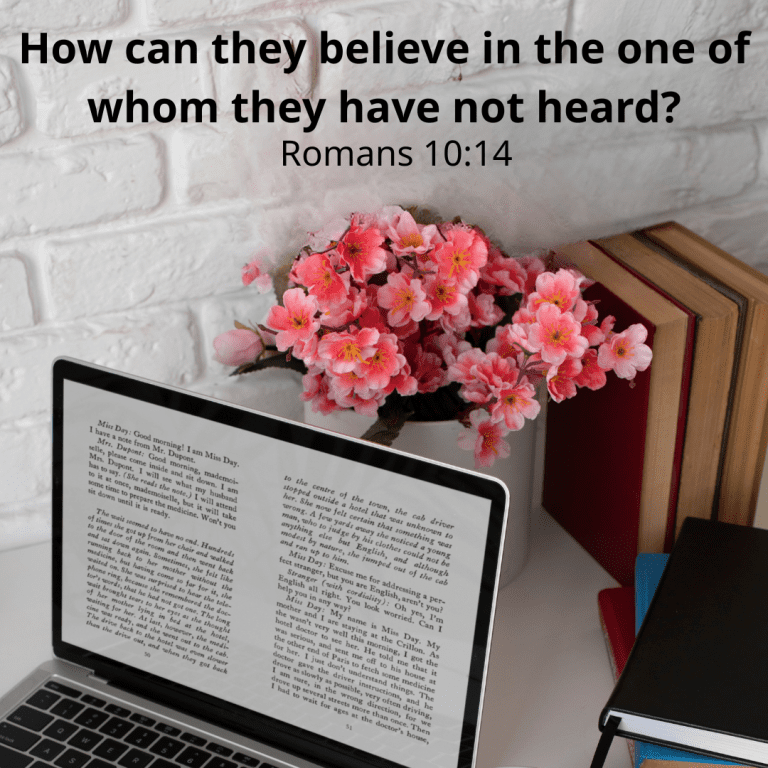
5. Romans 10:14 – “How can they believe in the one of whom they have not heard?”
You can’t believe a message you’ve never understood. That’s why translation is more than a technical process, it’s a lifeline. It’s like getting urgent news in a language you actually comprehend, instead of in one that leaves you guessing. Faith grows when the Gospel comes to you without a language barrier blocking the way.
6. 1 Corinthians 14:9 – “Unless you speak intelligible words… how will anyone know what you are saying?”
Ever been in a group chat where everyone is using inside jokes or slang you don’t know? You feel left out, even if the conversation is meant to include you. God’s Word is too important to be “lost in translation.” That’s why He makes sure it’s not just available, but understandable, so that no one has to scroll past the greatest message ever told because it feels out of reach.
7. Matthew 28:19–20 – *”Go and make disciples of all nations…” *
“All nations” isn’t just geography ,it’s culture, it’s language, it’s the way people think and express themselves. The Great Commission is, at its core, a Great Translation Mission. Jesus’ final command is an open invitation to take His words into every linguistic space.
Final Challenge
God is not a distant voice speaking in a code you have to crack. He’s the one who speaks your slang, your memes, your mother tongue, your unfiltered prayers. This World Translation Day, remember: God doesn’t wait for you to learn His language, He comes speaking yours. And when you share His Word, you’re joining that same mission, making sure no one misses the message because they couldn’t understand it.
Get ready to mark your calendars with colorful crayons because April 2nd isn’t just any ordinary day – it’s International Children’s Book Day! This day is all about diving into the charming world of children’s literature. It’s like a giant hug for books and a high-five for reading, inspiring kids everywhere to embark on grand adventures through the pages of their favorite stories. This special day aims to promote children’s books and reading, as well as to inspire a love of literature among children worldwide. So grab your favorite cozy spot, your trusty bookmark, and let’s journey together through the wonderful land of books!
As you celebrate International Children’s Book Day, it’s an opportune moment to reflect on the profound impact of Bible stories in the lives of your little ones. The Bible itself is a rich source of storytelling, filled with narratives that have captivated hearts and minds for generations. The stories within the Bible speak to the core of human experience and offer guidance for living a life of faith and virtue.
Bible Story books hold significant importance as books for children for several reasons:
- Guidance on what is right and wrong: The Bible contains timeless stories that teach important moral and ethical lessons, such as kindness, compassion, honesty, and forgiveness. These stories provide children with a foundation for understanding right from wrong and help shape their character and values. An example is the story of The Good Samaritan (Luke 10 v 25-37).
- Spiritual and Religious Education: The Bible serves as a fundamental tool for teaching children about faith, spirituality, and the principles of Christianity. It helps children develop a sense of connection God and understand their place within their respective communities. An example is the story of Daniel in the lions’ den (Daniel 6).
- Value in literature: Many stories in the Bible are beautifully crafted narratives with rich imagery, symbolism, and poetic language. Introducing children to these stories can foster an appreciation for literature and storytelling, enhancing their language skills and imagination. An example is the Creation story (Genesis 1 -2).
- Source of Comfort and Guidance: The Bible offers comfort and reassurance to children during difficult times. Its stories of hope, perseverance, and divine love can provide comfort and guidance when children face challenges or uncertainties in their lives. The story of Jairus’ daughter (Mark 5 v 21-43).
- Family and Community Bonding: Reading and discussing Bible stories together as a family or within a religious community can strengthen familial bonds and create a sense of belonging and shared identity. It provides opportunities for meaningful conversations and connections between generations. Story of Joseph and his brothers (Genesis 37-50).
- Critical Thinking and Reflection: Encouraging children to engage critically with the stories and teachings of the Bible fosters their ability to think analytically, ask questions, and reflect on their own beliefs and values. This critical thinking skill is essential for their intellectual and spiritual development. The Parable of the Talents (Matthew 25:14-30)
It is very important that you take part in this celebration (Established by the International Board on Books for Young People (IBBY)) by making Bible story books a priority in your children’s reading materials, educational settings, and households. You must focus not only on developing their intellect but also on shaping their character, preparing them to face life’s trials with integrity and determination. Let’s unite in embracing the wisdom found in these stories, planting the seeds for a future marked by compassion and enlightenment for all.

How does the Bible view women? At face value, some of its messages and examples can seem oppressive or devaluing. But when you learn more about how Jesus responded to the Bible’s historical and cultural context, you may rethink your first impressions. Christ entered into a specific time and culture that had assumptions very different from ours. How can understanding the biblical context inform our reading? How can the context help us to better understand who Jesus is—what he values, loves, and expects of his followers? Take a look, traveling all the way back to the culture Jesus entered.
How the Greeks Viewed Women
Let’s begin with the philosophers. Writers and thinkers often infuse a culture with certain beliefs—and this was especially so in the Greco-Roman world. When examined closely, some of their ideas may seem surprisingly antiquated to the modern reader.
For example, the revered philosopher Plato believed that women should be confined to the home while men tended to the business of state and commerce. Aristotle went even further, teaching that women were inferior to men, incapable of abstract thought, and emotionally volatile. Thus husbands and fathers were to rule over their wives and daughters. This thinking reflects the basic attitude toward women during the classical period.
How did these attitudes affect a woman’s life? The picture is not a pretty one. A young Greek girl is routinely married off to an older man. Her husband is free to take a concubine, and romantic love is not expected within marriage. Her role is to bear and raise children and run the household. She will rarely leave the house. Her education is limited to learning domestic tasks. She is not permitted to vote or hold property. Why would she be? As Euripides the playwright notes, “A woman is handicapped by intellect.” Thucydides helps him along by writing, “The name of a decent woman, like her person, should be shut up in the house.”
How the Jews Viewed Women
By Jesus’s time Greek ideas—including these ideas about women—had gradually crept into Jewish culture, despite Old Testament writings to the contrary. In the creation account in Genesis, God creates human beings as both male and female, giving them co-equal stewardship over the earth (Genesis 1:26-30). Throughout the Old Testament, women are given equal access to God’s law and held equally responsible to keep it.
The Old Testament record is replete with women whose great courage often surpasses that of the men around them. The stories of Miriam, Rahab, Ruth, Deborah, Hannah, Abigail, and Esther are prime examples of women whose insight and fortitude greatly influence the biblical narrative and the way God’s people understood themselves.
The Jewish understanding of women was so affected by exile, conquest, and trade that by Jesus’s time women were discouraged from studying Torah, God’s law, and encouraged to stay home to fulfill household duties. They attended synagogue assemblies seated separately from the men. The Greek-educated Jewish philosopher Philo, a contemporary of Jesus, saw women as having weak judgment and considered them unfit to learn the law. Some rabbis even went so far as to encourage men to limit their conversations with their own wives. What was the point of talking to someone with little knowledge of the law?
How Jesus Viewed Women
Into this distortion of God’s original intent for women comes a new teacher, the rabbi called Jesus of Nazareth. What do we know about Jesus’s relationships with women? Did he hold the same opinions as his culture? Let’s take a look at a few of his encounters with women.
Jesus speaks to a Samaritan woman in public (John 4:4-30)
Jesus shocks the woman at the well by asking her for a drink. Thus he steamrolls over cultural taboos against men speaking to women as well as Jewish prejudice against Samaritans. “You are a Jew and I am a Samaritan woman. How can you ask me for a drink?”
Jesus then reveals himself to her as the Messiah and the giver of the living water for which she longs.
Jesus teaches a woman one-on-one (Luke 10:38-42)
Women were not expected to study Torah, yet this renegade rabbi singles out one woman and opens Scripture to her. Mary “sat down at the feet of the Lord and listened to his teaching.” This position was that of the traditional rabbinic student.
When her sister complains about needing help, Jesus tells her that “Mary has chosen what is better, and it will not be taken away from her.”
Jesus comforts a widow and confronts death (Luke 7:11-17)
“Don’t cry,” Jesus says to a grieving widow whose son lies dead in his coffin. He touches the coffin, defying ceremonial law. Jaws drop in amazement as the young man sits up and begins to speak. Jesus gives the widow’s son back to her, alive and well.
Jesus touches an “unclean” woman (Luke 8:43-48)
Ceremonially unclean due to a chronic hemorrhage, a woman touches the hem of Jesus’ cloak. “Daughter,” Jesus speaks tenderly. “Your faith has healed you. Shalom.”
Jesus touches an infirm woman (Luke 13:10-16)
The religious leaders object to Jesus’s laying his healing hands on a crippled woman on the Sabbath.
“You hypocrites!” Jesus does not mince words. “Any one of you would untie your ox or your donkey from the stall and take it out to give it water on the Sabbath.Now here is this descendant of Abraham whom Satan has kept in bonds for eighteen years; should she not be released on the Sabbath?”
Jesus deals with a woman caught in adultery (John 8:1-11)
The woman’s accusers are silenced by Jesus’s words, “Whichever one of you has committed no sin may throw the first stone at her.” But he is gentle in his conversation with her.
Jesus allows Mary to anoint him (John 12:1-8)
When people are horrified at Mary’s extravagant outpouring of love, Jesus silences them all. Rather than rebuking her for touching him in this intimate way, he lavishes high praise on her. “Leave her alone; she’s anointing me for burial. This story will be told wherever the Gospel is preached.”
Jesus appears first to a woman after his Resurrection (John 20:11-18)
Although women were considered to be unreliable witnesses in court, Jesus assigns Mary Magdalene the task of being the first witness to the Resurrection.
Scripture’s Good News for Women
So what did Jesus really think of women? Did he touch them? Did he talk with them? Did he teach them? Did he give equal moral standing with men? Did he value them?
The record speaks for itself. First-century women in Palestine were second-class citizens. Sadly, some church leaders have still viewed and treated women in this way. But Jesus turned the tables on his culture, and his example calls us to do the same. Again and again, Jesus affirmed women’s value and dignity.
As the apostle Paul affirms in Galatians 3:26-28 (NIV): “So in Christ Jesus you are all children of God through faith, for all of you who were baptized into Christ have clothed yourselves with Christ. There is neither Jew nor Gentile, neither slave nor free, nor is there male and female, for you are all one in Christ Jesus.”