
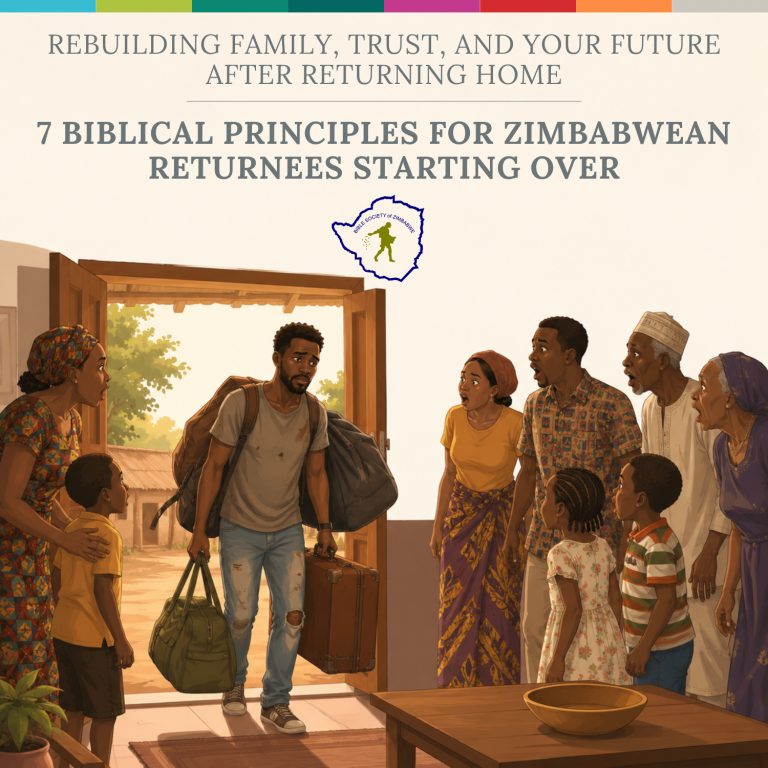
7 Biblical Principles for Zimbabwean Returnees Starting Over
Walking back into your family home after years away can feel… awkward. The children who once called you “Uncle” or “Auntie” are now adults. Your younger siblings have families of their own. Your parents have grown older. Your cousins have built lives you know very little about. And now, because of the xenophobic attacks in South Africa, you’re living under someone else’s roof again.
You may be grateful to be safe.
But you may also feel like you’re an inconvenience.
You might wonder:
“Will they get tired of me?”
“How long can I stay here?”
“What if they think I’ve failed?”
These feelings are normal.
Starting over isn’t just about finding a job or starting a business, it’s also about rebuilding relationships. The good news is this: every strong future begins with strong foundations, and family can become part of that foundation if we choose humility, gratitude, and wisdom.
1. Start with Gratitude, Not Expectations
Colossians 3:15 (NIV)
“And be thankful.”
Your relatives didn’t have to open their home to you. Many families are already carrying financial pressures of their own. A simple “thank you” goes further than you think.
Don’t assume hospitality.
Appreciate it.
Small acts matter.
Wash the dishes.
Sweep the yard.
Cook a meal.
Help with the children.
Run errands.
Gratitude isn’t just something you say. It’s something you demonstrate. People may forget your words, but they’ll remember how you made life easier for them.
2. Don’t Try to Pick Up Where You Left Off
Romans 12:18 (NIV)
“If it is possible, as far as it depends on you, live at peace with everyone.”
Years have passed, people have changed, family dynamics have changed. Don’t expect relationships to feel exactly as they did before you left.
Instead of saying,
“You’ve changed.”
Ask questions, listen, get to know your relatives again. Celebrate their milestones. Learn their routines. Rebuilding trust takes time, but every meaningful conversation lays another brick in the relationship.
3. Choose Humility Over Pride
Philippians 2:3-4 (NIV)
“Do nothing out of selfish ambition or vain conceit. Rather, in humility value others above yourselves, not looking to your own interests but each of you to the interests of the others.”
Living with relatives means adjusting to their way of doing things.
Their house has its own rules.
Respect them.
If they eat dinner at a certain time, join them.
If they have household responsibilities, ask where you can help.
Humility isn’t weakness.
It’s maturity.
People are more likely to support someone who is willing to learn than someone who acts entitled.
4. Be a Contributor, Not Just a Guest
Acts 20:35 (NIV)
“It is more blessed to give than to receive.”
Even if you don’t have money yet, you still have something to offer.
Your time.
Your skills.
Your energy.
Can you repair a broken gate?
Help a child with homework?
Fix a leaking tap?
Start a vegetable garden?
Teach someone a skill you learned while living in South Africa?
Contribution changes how people see you, and how you see yourself.
You stop feeling like a burden and start becoming part of the solution.
5. Let Go of Shame and Ask for Wise Advice
Proverbs 15:22 (NIV)
“Plans fail for lack of counsel, but with many advisers they succeed.”
You don’t have to figure everything out alone. Your relatives may know people who are hiring. They may know someone looking for a business partner. They may have advice about your community that you don’t have yet. Don’t let pride stop you from learning. Asking for guidance isn’t admitting defeat. It’s taking the first step toward rebuilding.
6. Build Trust Before You Build a Business
Luke 16:10 (NIV)
“Whoever can be trusted with very little can also be trusted with much…”
Before people invest in your dream, they’ll watch your character.
Are you dependable?
Do you keep your word?
Do you respect other people’s property?
Do you show up when you say you will?
Trust is one of the greatest forms of capital you’ll ever have.
Strong relationships often open doors that qualifications alone cannot.
7. Leave the House Better Than You Found It
Matthew 5:16 (NIV)
“Let your light shine before others, that they may see your good deeds and glorify your Father in heaven.”
One day you’ll move into your own place.
When that day comes, what will your relatives remember?
Will they remember someone who complained?
Or someone who brought peace?
Will they remember someone who only received?
Or someone who gave back?
Your season of staying with family is temporary.
But the relationships you build can last a lifetime.
Leave behind gratitude, kindness, and respect, not tension and resentment.
Your Family Is Not Your Finish Line
The goal isn’t to depend on your relatives forever. The goal is to use this season wisely. Reconnect.
Heal.
Save.
Learn.
Work.
Plan.
Then take the next step toward independence. There is no shame in receiving help for a season. The key is not to settle into dependency when God is calling you toward growth.
Final Thoughts
If you’re a returnee, remember this:
Coming home doesn’t make you less valuable. Living with relatives doesn’t mean you’ve failed. This season is not your identity. It’s your starting point. Use it to rebuild trust. Reconnect with family. Serve where you can. Learn from those around you.
And prepare for the day when you’ll be able to open your own door, not only for yourself, but for someone else who needs a safe place to begin again, because that’s what builders do. They remember the people who helped them stand, and when their own foundation is strong, they help others build too.
The Holy Spirit is not just an abstract concept or a mystical force; He is a personal and powerful presence in the life of every believer. Understanding His role and allowing Him to actively work in our lives is essential for spiritual growth and victorious Christian living. In this article, we will delve into the transformative influence of the Holy Spirit, supported by biblical narratives and reflections, and see how He continues to work in the lives of believers today.
1. The Holy Spirit as Our Guide
One of the most profound ways the Holy Spirit works in a believer’s life is by guiding us through the complexities of life. Jesus promised this guidance when He said:
John 16:13 (RSV) – “When the Spirit of truth comes, he will guide you into all the truth; for he will not speak on his own authority, but whatever he hears he will speak, and he will declare to you the things that are to come.”
Consider the story of Philip and the Ethiopian eunuch (Acts 8:26-40). Philip, led by the Spirit, approached the chariot and explained the Scriptures, resulting in the eunuch’s conversion and baptism. This narrative highlights how sensitive obedience to the Spirit’s guidance can lead to profound outcomes.
Today, believers can experience the Holy Spirit’s guidance in everyday decisions—whether in career choices, relationships, or ministry. Many testify of the Spirit’s prompting to reach out to someone in need or speak a word of encouragement at just the right moment.
2. The Spirit Who Empowers
The empowerment of the Holy Spirit is vividly portrayed at Pentecost. After Jesus’ ascension, the disciples were unsure and fearful. But when the Spirit descended upon them, they were transformed into bold witnesses.
Acts 1:8 (RSV) – “But you shall receive power when the Holy Spirit has come upon you; and you shall be my witnesses in Jerusalem and in all Judea and Samaria and to the end of the earth.”
Peter, who once denied Christ, boldly preached, leading to the conversion of about three thousand people (Acts 2:14-41). The Spirit’s power equips ordinary people to perform extraordinary acts of faith.
This empowerment is evident when believers boldly share their faith despite challenges or speak truth in situations where silence seems easier. The Spirit gives us courage to act according to God’s will.
3. The Spirit as Comforter
Life’s challenges can leave us weary and disheartened. The Holy Spirit, however, comes as a Comforter, assuring us of God’s presence in our pain.
John 14:16-17 (RSV) – “And I will pray the Father, and he will give you another Counselor, to be with you forever, even the Spirit of truth.”
When Paul faced persecution and hardship, he found comfort through the Spirit’s inner strengthening (2 Corinthians 1:3-5). This divine comfort enabled him to endure and continue his mission.
In modern life, believers find comfort when overwhelmed by grief, loss, or uncertainty. Through prayer and worship, the Holy Spirit brings peace that surpasses understanding, reminding us that we are never alone.
4. The Spirit of Transformation
Paul emphasizes the transformative work of the Holy Spirit in believers:
Romans 8:11 (RSV) – “If the Spirit of him who raised Jesus from the dead dwells in you, he who raised Christ Jesus from the dead will give life to your mortal bodies also through his Spirit which dwells in you.”
When the Spirit transforms a believer, old habits, sins, and weaknesses are replaced with new life, marked by the fruit of the Spirit (Galatians 5:22-23). This transformation is not instantaneous but a continual process as we yield to His work.
In today’s context, transformation might involve overcoming addiction, finding hope amidst despair, or growing in patience and love. Believers experience gradual yet profound change as they submit daily to the Spirit’s leading.
5. The Holy Spirit and Fellowship
Unity among believers is one of the key works of the Holy Spirit:
1 Corinthians 12:13 (RSV) – “For by one Spirit we were all baptized into one body—Jews or Greeks, slaves or free—and all were made to drink of one Spirit.”
The early church exemplified this unity. Despite differences in background and social status, they were of one heart and mind (Acts 4:32). The Holy Spirit cultivates a spirit of love and collaboration within the body of Christ.
In today’s diverse church communities, the Spirit continues to break down barriers of race, culture, and background, fostering unity and love among believers. Small groups, communal worship, and service projects often become places where the Spirit knits hearts together.
6. The Spirit of Intercession
One of the profound ways the Holy Spirit helps believers is through intercession. When we face situations where words fail us, the Spirit steps in, praying on our behalf.
Romans 8:26 (RSV) – “Likewise the Spirit helps us in our weakness; for we do not know how to pray as we ought, but the Spirit himself intercedes for us with sighs too deep for words.”
This powerful assurance means that even in moments of despair or confusion, when prayer seems impossible, the Holy Spirit prays for us according to the will of God. Modern believers often experience this in moments of deep worship or crisis when words are inadequate. Trusting that the Spirit intercedes brings comfort and peace.
7. The Spirit as the Giver of Spiritual Gifts
The Holy Spirit equips believers with spiritual gifts to build up the church and serve God effectively. These gifts are diverse, ranging from wisdom and knowledge to healing and prophecy.
1 Corinthians 12:4-7 (RSV) – “Now there are varieties of gifts, but the same Spirit; and there are varieties of service, but the same Lord; and there are varieties of working, but it is the same God who inspires them all in every one. To each is given the manifestation of the Spirit for the common good.”
Believers are encouraged to seek and develop their spiritual gifts, using them to serve others and glorify God. Whether in church leadership, creative ministries, or everyday acts of kindness, the Spirit empowers believers to make a difference.
Living by the Spirit
The Christian life is not merely about following rules but about being led by the Spirit. It requires daily surrender and openness to His leading. As we allow the Spirit to work within us, our lives bear witness to His power and grace. From guiding and comforting to empowering and transforming, the Holy Spirit is actively involved in every aspect of a believer’s journey.
Today, believers can cultivate sensitivity to the Spirit through prayer, meditation on Scripture, and staying connected to a faith community. As we walk in step with the Spirit, we reflect Christ’s love and power in a world in need of hope.
The Holy Spirit is a vital part of the Christian faith, yet many believers struggle to understand who He truly is and what role He plays in their lives. In this article, we will explore the identity of the Holy Spirit using seven powerful Bible verses to help deepen our understanding.
1. The Holy Spirit as Comforter and Advocate
John 14:16-17 (RSV) – “And I will pray the Father, and he will give you another Counselor, to be with you for ever, even the Spirit of truth, whom the world cannot receive, because it neither sees him nor knows him; you know him, for he dwells with you, and will be in you.”
Jesus promised His disciples that the Holy Spirit would come as an Advocate—someone who stands by us, guiding and comforting. The Holy Spirit is not just a distant force but a constant presence who supports and defends believers.
2. The Spirit of Truth
John 16:13 (RSV) – “When the Spirit of truth comes, he will guide you into all the truth; for he will not speak on his own authority, but whatever he hears he will speak, and he will declare to you the things that are to come.”
The Holy Spirit is referred to as the Spirit of Truth because He leads us into a deeper understanding of God’s Word and His will. This guiding role helps believers discern right from wrong and stay aligned with God’s purposes.
3. The Giver of Power
Acts 1:8 (RSV) – “But you shall receive power when the Holy Spirit has come upon you; and you shall be my witnesses in Jerusalem and in all Judea and Samaria and to the end of the earth.”
One of the most significant roles of the Holy Spirit is empowering believers to be witnesses for Christ. Through His power, we are not only transformed internally but also equipped to spread the message of the Gospel with boldness.
4. The Divine Teacher
John 14:26 (RSV) – “But the Counselor, the Holy Spirit, whom the Father will send in my name, he will teach you all things, and bring to your remembrance all that I have said to you.”
The Holy Spirit is our Teacher, helping us understand and remember the teachings of Jesus. This guidance is essential as we grow in faith and navigate life’s challenges.
5. The Spirit Who Gives Life
Romans 8:11 (RSV) – “If the Spirit of him who raised Jesus from the dead dwells in you, he who raised Christ Jesus from the dead will give life to your mortal bodies also through his Spirit which dwells in you.”
The same power that raised Christ from the dead lives in believers, breathing life into our mortal bodies. This resurrection power not only brings physical renewal but also spiritual vitality.
6. The Seal of Belonging
Ephesians 1:13 (RSV) – “In him you also, who have heard the word of truth, the gospel of your salvation, and have believed in him, were sealed with the promised Holy Spirit.”
The Holy Spirit marks us as belonging to God. This seal is a guarantee of our inheritance in Christ and serves as a constant reminder that we are His.
7. The Spirit Who Unites
1 Corinthians 12:13 (RSV) – “For by one Spirit we were all baptized into one body—Jews or Greeks, slaves or free—and all were made to drink of one Spirit.”
The Holy Spirit unites believers into one body, transcending racial, social, and cultural differences. Through the Spirit, we become one in Christ, fostering unity within the church.
Embracing the Holy Spirit
Understanding who the Holy Spirit is transforms how we live out our faith. He is not just a divine presence but a Comforter, Advocate, Teacher, and Source of power and unity. As we walk with Him daily, we experience His guidance and embrace the life He offers.
May we continually seek a deeper relationship with the Holy Spirit, allowing His influence to shape every aspect of our lives.
Heroes’ Day is an occasion to honor and celebrate the courage, sacrifice, and impact of heroes who have shaped our lives and communities. In the Bible, we find many stories about men and women whose lives reflect profound faith and steadfastness. These biblical heroes serve as timeless examples of virtues we can aspire to in our own lives.
Abraham: The Father of Faith
Abraham, often referred to as the “father of faith,” is a towering figure in the Bible. His story is one of unwavering trust in God. When God called Abraham to leave his homeland and go to a place he would be shown, Abraham obeyed without hesitation (Genesis 12:1-4). His willingness to sacrifice his son Isaac, trusting in God’s promise, is a testament to his profound faith (Genesis 22:1-18).
Moses: The Deliverer
Moses is celebrated as the deliverer of Israel from slavery in Egypt. His life is marked by acts of extraordinary bravery and faith. Despite his initial reluctance, Moses answered God’s call to lead the Israelites out of bondage, facing Pharaoh’s wrath and the perils of the wilderness (Exodus 3-14). His leadership and unwavering reliance on God highlight the importance of faith and perseverance.
Esther: The Courageous Queen
Esther, a Jewish queen in Persia, displayed remarkable courage and wisdom. When her people faced destruction, Esther risked her life by approaching King Xerxes uninvited to plead for their salvation. Her famous declaration, “If I perish, I perish,” (Esther 4:16) shows her bravery and selflessness in the face of great danger.
David: The Shepherd King
David, the shepherd boy who became king, is renowned for his faith and courage. His defeat of the giant Goliath with a sling and a stone is a powerful example of trusting in God’s strength rather than human might (1 Samuel 17). David’s life, though marked by imperfections, is a testament to God’s grace and the power of repentance.
Daniel: The Uncompromising Prophet
Daniel’s story is one of steadfast faith in a foreign land. Despite the threat of death, he refused to give up on his faith, continuing to pray to God even when it was not allowed. His survival in the lions’ den (Daniel 6) is a powerful reminder of God’s protection over those who remain faithful to Him.
Mary: The Obedient Servant
Mary, the mother of Jesus, exemplifies obedience and humility. When the angel Gabriel announced that she would bear the Son of God, Mary’s response was one of submission to God’s will: “I am the Lord’s servant. May your word to me be fulfilled” (Luke 1:38). Her faith and willingness to accept God’s plan played a crucial role in the story of salvation.
Paul: The Zealous Apostle
Paul, once a persecutor of Christians, became one of the most zealous apostles of Christ. His missionary journeys, tireless preaching, and numerous epistles have profoundly shaped Christian theology and practice. Paul’s transformation and dedication to spreading the gospel, despite immense suffering and persecution, are inspiring examples of redemption and commitment (Acts 9, 2 Corinthians 11:23-28).
Conclusion
As we celebrate Heroes’ Day, these biblical figures remind us that true heroism is rooted in faith, obedience, and a willingness to serve God’s purpose, even at great personal cost. Their stories encourage us to cultivate these virtues in our own lives, trusting that God can use ordinary people to accomplish extraordinary things.
Individuals working together can achieve far more than they could alone. Here are seven powerful Bible verses that emphasize the strength found in numbers and the divine wisdom behind collective effort.
1. Ecclesiastes 4:9
“Two are better than one, because they have a good return for their labor.
Having others by our side multiplies our capacity to endure and succeed. Unity provides resilience and strength.
2. Proverbs 27:17
“As iron sharpens iron, so one person sharpens another.”
Just as iron sharpens iron, people improve and refine each other through interaction, support, and sometimes even constructive criticism. There is necessity of community for personal growth and strength.
3. Matthew 18:20
“For where two or three gather in my name, there am I with them.”
Jesus reassures His followers that His presence is magnified when they come together in His name. This promise of divine presence reinforces the idea that gathering as a community not only strengthens human bonds but also invites God’s active participation and blessing.
4. 1 Corinthians 12:12
“Just as a body, though one, has many parts, but all its many parts form one body, so it is with Christ.
Each member within a community has a unique role, and together they form a complete, functioning whole. This interdependence ensures that the community is stronger and more effective than any single member could be alone.
5. Hebrews 10:24
“And let us consider how we may spur one another on toward love and good deeds,
In a world that often promotes individualism, this call to gather and support one another remains profoundly powerful.
6. Acts 2:44
All the believers were together and had everything in common.
The early church’s shared life, mutual support, and communal worship were sources of strength and growth. This highlights the power of collective living and the positive impact it has on both the community and its outreach.
7. Ephesians 4:11
“So Christ himself gave the apostles, the prophets, the evangelists, the pastors and teachers.
The diversity of gifts within the church play a role to build up the community towards unity and maturity in faith. Each role is crucial, and together, they contribute to the growth and strength of the entire body of Christ.