

Disagreeing with your parents does not mean you are disrespectful. This article shares seven Bible verses, including Exodus 20:12, Ephesians 6:1, Proverbs 15:1 and Acts 5:29, showing how to listen, communicate gently, seek God’s wisdom and honour your parents while still making responsible, faith-led decisions as you mature into adulthood.
So, because I disagree with my parents, does that mean I’m disrespectful? Maybe your parents want you to pursue a career you don’t like. Maybe they don’t approve of your relationship. Or perhaps you’re an adult trying to make your own decisions, but every disagreement leaves you feeling guilty.
You’ve probably heard the Bible say, “Honour thy father and thy mother.” But does honouring your parents mean saying yes to everything, even when you believe a different choice is right for you?
Let’s explore seven Bible verses that can help you navigate these difficult conversations with wisdom, faith and maturity.
1. Exodus 20:12 — Honour Your Parents
“Honour thy father and thy mother: that thy days may be long upon the land which the LORD thy God giveth thee.” — KJV
Honouring your parents means treating them with love and respect, appreciating their sacrifices and valuing their contribution to your life. Even when you disagree, you can choose to communicate respectfully.
2. Ephesians 6:1 — Children, Obey Your Parents
“Children, obey your parents in the Lord: for this is right.” — KJV
Children need parental guidance, protection and appropriate rules. As they grow into adulthood, however, they take on greater responsibility for their own decisions. Honouring parents remains important, but it does not mean surrendering every adult choice to them.
3. Proverbs 1:8 — Listen to Their Wisdom
“My son, hear the instruction of thy father, and forsake not the law of thy mother.” — KJV
Parents often speak from experience and concern. Even if you disagree with their advice, listen and consider their perspective. You may discover valuable wisdom, even when you ultimately make a different decision.
4. James 1:19 — Listen Before You Respond
“Let every man be swift to hear, slow to speak, slow to wrath.” — James 1:19, KJV
Disagreements can quickly become arguments when emotions take over. Listen to your parents, allow them to explain their concerns and share your views calmly. You can stand by your decision without being disrespectful.
5. Romans 12:2 — Seek God’s Wisdom
“Be ye transformed by the renewing of your mind, that ye may prove what is that good, and acceptable, and perfect, will of God.” — KJV
God calls us to develop discernment. When making important decisions, pray, study Scripture and seek wise counsel. Do not dismiss your parents’ advice simply because you disagree, but take responsibility for making thoughtful choices.
6. Proverbs 15:1 — Disagree With Kindness
“A soft answer turneth away wrath: but grievous words stir up anger.” — KJV
How you communicate matters. Instead of responding with anger, explain your perspective gently. You may not reach an agreement, but respectful communication can help preserve your relationship.
7. Acts 5:29 — Put God First
“We ought to obey God rather than men.” — KJV
The apostles spoke these words when they were ordered to stop proclaiming the Gospel. Their example reminds us that human authority has limits when it conflicts with God’s commands. This is not an excuse to reject every instruction we dislike, but a reminder to put God first.
Can You Honour Your Parents and Still Disagree?
Yes! Honouring your parents does not mean agreeing with everything they say. Children need guidance, while adults must increasingly take responsibility for their own choices. Both can listen, communicate respectfully and maintain loving relationships.
The goal is not to win arguments or prove your parents wrong. It is to grow in wisdom, act responsibly and treat them with love, even when your opinions differ.
Remember: You can disagree without dishonouring, make your own decisions without rejecting your parents, and remain respectful without giving up your convictions.

Not everyone will understand your boundaries, but Scripture shows you can stand firm with kindness. These seven NIV Bible verses teach you to speak truth in love, say a respectful no, pause before reacting, pursue peace, resist people pleasing, guard your heart and choose gentle words without guilt or harshness.
Have you ever said no to someone, only to be called selfish? Maybe you declined a favour, stepped back from a draining friendship or turned down another church commitment.
Suddenly, you’re questioning yourself. Am I wrong for protecting my peace?
Not everyone will understand your boundaries. But you can stand firm in your decisions while treating others with love and respect. Here’s what the Bible says.
1. Speak the Truth in Love
Ephesians 4:15 (NIV)
“Instead, speaking the truth in love…”
Being honest doesn’t mean being harsh. If someone’s behaviour hurts you, explain how you feel without attacking them.
Try this: “I value our friendship, but I need you to respect my decision.”
2. You Don’t Have to Explain Everything
Matthew 5:37 (NIV)
“All you need to say is simply ‘Yes’ or ‘No’…”
You decline an invitation, and suddenly you’re defending your decision. Remember, a respectful no is enough. You don’t need everyone’s approval to make a reasonable choice.
Try this: “Thank you for inviting me, but I won’t be able to make it.”
3. Pause Before You React
James 1:19 (NIV)
“Everyone should be quick to listen, slow to speak and slow to become angry.”
When someone calls you selfish, it’s tempting to fire back. Take a breath, listen and respond calmly. You can stand your ground without turning the conversation into an argument.
4. You Can Disagree and Still Pursue Peace
Romans 12:18 (NIV)
“If it is possible, as far as it depends on you, live at peace with everyone.”
You can communicate respectfully, but you cannot control how others respond. Do your part to make peace without abandoning your values or accepting mistreatment.
5. Stop Living for Everyone’s Approval
Galatians 1:10 (NIV)
“Am I now trying to win the approval of human beings, or of God?”
Afraid your friends will exclude you or your family will misunderstand you? It’s impossible to please everyone. Make wise, faith-centred decisions instead of letting guilt control you.
6. Protect Your Heart
Proverbs 4:23 (NIV)
“Above all else, guard your heart, for everything you do flows from it.”
If someone repeatedly ignores your boundaries, pay attention. You can forgive them while taking time to rebuild trust or creating some distance. Love doesn’t require you to accept repeated disrespect.
7. Choose Your Words Carefully
Proverbs 15:1 (NIV)
“A gentle answer turns away wrath, but a harsh word stirs up anger.”
When someone says, “You’ve changed!” you don’t have to respond with anger. Explain your decision calmly. Being gentle doesn’t mean giving in; it means standing firm without deliberately hurting others.
You Can Be Kind and Still Say No
Not everyone will agree with your boundaries, and that’s okay. Focus on communicating honestly, acting with love and remaining open to correction.
You can forgive without immediately restoring trust. You can say no without being disrespectful. And you can pursue peace without pretending everything is okay.
Reflection: Is there a difficult conversation you’ve been avoiding? How can you approach it with both courage and kindness?
Ask God for wisdom, choose your words carefully and remember: standing firm doesn’t mean you have to stop loving people.

How Families Can Receive Returnees From South Africa with Love
Returning home after being forced to leave South Africa can be an emotional and difficult experience. For some returnees, coming home may bring relief because they are reunited with family. For others, it may bring embarrassment, disappointment, financial pressure and uncertainty about what comes next.
This is where family matters.
The first few days and weeks after returning can shape how a person begins to rebuild. Families can either make the returnee feel like a failure, or remind them that home is still a place where they are loved, valued and accepted.
The Bible gives us principles that can guide families in creating that kind of welcome.
1. Welcome Them Before You Question Them
When someone returns, the natural reaction may be to ask:
“What happened?”
“Why were you sent back?”
“Where is the money you made?”
“What happened to your belongings?”
But sometimes, the person first needs to hear:
“Welcome home. We are glad you are here.”
The story can come later.
Jesus’ story of the prodigal son gives us a powerful picture of a father who saw his son returning and ran to welcome him.
“So he got up and went to his father. But while he was still a long way off, his father saw him and was filled with compassion for him; he ran to his son, threw his arms around him and kissed him.” — Luke 15:20 (NIV)
The father did not begin by interrogating his son.
He welcomed him.
Families can learn from this. Before asking what happened in South Africa, make sure the returnee knows that they are wanted at home.
2. Listen Without Turning Their Story Into a Courtroom
Some returnees may want to talk immediately. Others may need time.
Their experiences may involve difficult memories, loss, discrimination, unemployment, separation from loved ones or the sudden disruption of their lives.
Don’t force them to explain everything.
Instead, create an environment where they know:
“When you are ready to talk, I am here to listen.”
“Everyone should be quick to listen, slow to speak and slow to become angry.” — James 1:19 (NIV)
Listening does not mean agreeing with everything they say.
It means giving them enough space to tell their story without immediately judging, correcting or blaming them.
Sometimes what a returnee needs most is not advice, they simply need someone who will listen.
3. Don’t Make Them Feel Like They Failed
One of the most painful things for a returnee may be feeling that they have disappointed their family.
Perhaps they left expecting to send money home. Perhaps relatives expected them to return with a car, build a house or start a business.
Instead, they have returned with very little.
This can create enormous shame.
Families should resist statements such as:
“You were in South Africa all those years and came back with nothing?”
Instead, ask:
“What can we do to help you start again?”
“Carry each other’s burdens, and in this way you will fulfill the law of Christ.” — Galatians 6:2 (NIV)
A family should not add to someone’s burden.
4. Give Them a Safe Place to Rebuild
Coming home does not automatically mean that everything is okay.
A returnee may be wondering:
- Where will I work?
- How will I support my children?
- What can I do now?
- Will people respect me?
- Can I start a business?
- What will my friends say?
- Have I lost everything I worked for?
Family can become the safe environment from which the person begins rebuilding.
“Therefore encourage one another and build each other up, just as in fact you are doing.” — 1 Thessalonians 5:11 (NIV)
Encouragement is not pretending that everything is fine, it is helping someone believe that their current situation is not the end of their story.
5. Don’t Turn Their Return Into Family Gossip
A returnee’s story belongs to them.
Before sharing their situation with neighbours, church members, friends or extended family, consider how that might affect them.
Imagine returning home already feeling embarrassed, only to discover that everyone in the community knows what happened to you.
Families should protect the dignity of their returning loved ones.
“Love each other deeply, because love covers over a multitude of sins.” — 1 Peter 4:8 (NIV)
Love does not expose someone’s vulnerability for entertainment.
Love protects. Instead of discussing the returnee behind their back, create a culture where their dignity is respected.
6. Don’t Only Give Them Food—Help Them Find Their Future
Practical support is important.
A family may provide food, accommodation, clothing or transport. But long-term support also means helping the returnee think about what comes next.
Ask:
“What skills did you gain?”
“What kind of work would you like to do?”
“What can we help you start?”
“Who can we connect you with?”
The returnee may have skills and experiences that can be valuable back home.
“Each of you should use whatever gift you have received to serve others, as faithful stewards of God’s grace in its various forms.” — 1 Peter 4:10 (NIV)
Their journey may have been difficult, but it may also have given them skills, resilience and experience. Help them see what they still have, not only what they have lost.
7. Remind Them: They Still Belong
Perhaps the most important message a family can communicate is:
“You are still one of us.”
Circumstances may have changed.
Their finances may have changed.
Their plans may have changed.
But their value has not.
The Bible reminds us that our identity and worth ultimately come from God.
“See what great love the Father has lavished on us, that we should be called children of God!” — 1 John 3:1 (NIV)
A returnee should not be defined by deportation, unemployment, financial loss or what happened in South Africa. They are more than what happened to them. They are a person with dignity, gifts, relationships, dreams and a future.
A Final Word to Families
If someone you love has returned from South Africa, don’t make their homecoming another source of pain.
They may already be grieving a lost job, lost possessions, lost opportunities or a dream that did not work out as planned.
Let home be different.
Let it be the place where they can breathe.
Let it be the place where they are heard without judgment, supported without shame and encouraged to begin again.
They may have returned without everything they hoped for, but they have not returned without hope.
And sometimes, the first step toward rebuilding someone’s life is simply making sure they know:
“You are home. You are loved. You still belong.”

The knockout stage is win or go home, and faith has its own knockout moments. This World Cup devotional uses football’s setbacks, comebacks, and teamwork to teach seven lessons on persevering under trial, carrying one another, and keeping our eyes fixed on Christ.
1. No One Wins Without Setbacks
Monday 6 July
Few teams reach the final without first falling behind, and the greatest champions are not those who never stumble but those who refuse to stay down. God uses every trial to deepen our faith and strengthen our endurance.
James 1:12 “Blessed is the one who perseveres under trial because, having stood the test, that person will receive the crown of life that the Lord has promised to those who love him.”
Whatever knocked you down, get up, because defeat is never final with God.
2. Coming Back From Behind
Tuesday 7 July
Some of the greatest matches are won by teams that were trailing at half-time, when what looked like defeat became the setup for a famous comeback. God can turn our hardest seasons into the very thing that builds our character.
Romans 5:3-4 “We also glory in our sufferings, because we know that suffering produces perseverance; perseverance, character; and character, hope.”
Your current struggle may be setting up your greatest comeback.
3. Play Through the Pain
Wednesday 8 July
Champions keep running when their legs are burning, fixing their minds on the finish rather than the fatigue. Faith calls for that same endurance, pressing on when our own strength runs low.
Hebrews 12:1 “Let us run with perseverance the race marked out for us.”
Lay aside what slows you down and keep running today.
4. Pass the Ball
Thursday 9 July
No striker scores alone, and the best goals come from a teammate willing to give the ball away for the good of the team. Faith grows when we carry one another rather than playing only for ourselves.
Galatians 6:2 “Carry each other’s burdens, and in this way you will fulfill the law of Christ.”
Look around today and pass strength to someone who is struggling.
5. Great Teams Play for Something Bigger
Friday 10 July
The strongest teams are never just a collection of talented individuals, but a group bound by a shared purpose. Faith was never meant to be a solo journey either, because every believer belongs to God’s family.
1 Corinthians 12:27 “Now you are the body of Christ, and each one of you is a part of it.”
Find your place on the team, because the body needs the part only you can play.
6. The Crowd Cannot Play for You
Saturday 11 July
The crowd can cheer and roar its support, but it cannot step onto the field, for eventually the player must play. Others can point us toward God, yet no one can know Him on our behalf, because faith is personal.
Romans 14:12 “Each of us will give an account of ourselves to God.”
Make your faith your own today, because no one can run your race for you.
7. Keep Your Eyes on the Captain
Sunday 12 July
When the pressure rises, players look to their captain to steady the team and set the standard. Believers have the greatest Captain of all, and we run best when our eyes stay fixed on Jesus.
Hebrews 12:2 “Fixing our eyes on Jesus, the pioneer and perfecter of faith.”
This Sunday, lift your eyes off the pressure and onto Christ.
Conclusion
The knockout rounds test everything, and so does the life of faith. This week we rose from setbacks, ran through the pain, carried one another, and kept our eyes on our Captain. Strengthened together, we press on toward the final.

December is almost here, a month filled with excitement, celebrations, travelling, family gatherings, and sometimes a little chaos. As we close November, it’s the perfect moment to pause and prepare our hearts for the month ahead.
Here are some simple, practical Scripture Hacks, short, memorable, easy-to-use ways to keep God’s Word at the centre of your December. Each “hack” is paired with a Bible verse.
1. The “Morning Boost” Hack
Start your day with one verse before checking your phone.
Verse: “This is the day the Lord has made; let us rejoice and be glad in it.” — Psalm 118:24
It resets your mood and anchors your day in gratitude before the busyness kicks in.
2. The “Peace in My Pocket” Hack
Screenshot a calming verse and save it as your lock screen.
Verse: “You will keep in perfect peace those whose minds are steadfast.” — Isaiah 26:3
Every time you unlock your phone, you remind your heart to breathe and stay centred.
3. The “Speak Life” Hack
Choose one person every day to encourage with Scripture.
Verse: “Therefore encourage one another and build each other up.” — 1 Thessalonians 5:11
December can be overwhelming, a simple verse shared can lift someone’s whole day.
4. The “Stress Reset” Hack
When you feel overwhelmed, step away for 30 seconds and whisper one calming verse.
Verse: “Be still, and know that I am God.” — Psalm 46:10
It shifts your focus from pressure to peace.
5. The “Budget Wisdom” Hack
Before spending impulsively, read one verse on wisdom or self-control.
Verse: “The wise store up choice food and olive oil, but fools gulp theirs down.” — Proverbs 21:20
December spending can get wild, Scripture brings balance.
6. The “Hold Your Tongue” Hack
If someone tests your patience this festive season, remember this verse before responding.
Verse: “Everyone should be quick to listen, slow to speak and slow to become angry.” — James 1:19
Drama is avoided. Peace is preserved.
7. The “God’s Got This” Hack
Write one verse of trust on a sticky note and place it somewhere you see often.
Verse: “Trust in the Lord with all your heart and lean not on your own understanding.” — Proverbs 3:5
December can bring decisions and uncertainties, this keeps you grounded.
8. The “Joy Check” Hack
Before you end each day, list one moment where God showed up for you — big or small.
Verse: “The joy of the Lord is your strength.” — Nehemiah 8:10
It shifts your mind from stress to gratitude, ending your day with joy.
A Better December Starts Today
As November ends, these simple hacks help us enter December with calm hearts, wise decisions, and spiritually rooted habits. The Word isn’t just for Sunday, it’s a daily tool, a guide, a comfort, and a steady voice in every season.

We live in a world where almost everything is just a click away — opinions, substances, validation, or distractions. For the youth, the pressure to experiment, fit in, or numb out is massive. From parties to pills, vaping to pornography, hookup culture to hustler mindsets, there’s this silent rule that says, “Do what you want, no one cares.”
But you know what? God cares. And deep down, so do you. Here’s how you can stand firm and thrive in a culture that keeps telling you to let go.
1. 1 Corinthians 10:13 — “No temptation has overtaken you except what is common to mankind…”
You’re not alone in this.
Whether it’s the pressure to try drugs, get high to escape stress, or be someone you’re not just to fit in, you’re not weird or weak for struggling. Everyone faces temptation. The verse promises that God will always provide a way out. Sometimes that “way out” is a friend’s text, a parent’s question, or just that inner voice saying “Don’t do it.”
Story: Thomas tried weed at 16 because everyone at the party was doing it. He thought he’d be cooler, braver. But instead, he ended up anxious and ashamed. Years later, he discovered this verse and realized temptation didn’t define him, God had always offered a better choice.
2. Romans 12:2 — “Do not conform to the pattern of this world…”
The world screams, “Normalize it!”
God whispers, “Renew your mind.”
Peer pressure often starts with small things: music, jokes, drinks, risky DMs. But one compromise leads to another. This verse reminds us not to copy what the world says is okay. Transformation begins in the mind. What you feed your thoughts with — that’s what shapes your life.
Story: Margaret stopped following certain pages on Instagram — they weren’t evil, just misleading. After a month of feeding her mind differently, she felt lighter, freer, and more confident in who God said she was.
3. James 4:7 — “Submit yourselves, then, to God. Resist the devil, and he will flee from you.”
You have authority.
Temptation isn’t just a feeling — it’s spiritual warfare. You don’t fight it alone. Submitting to God isn’t weakness; it’s your superpower. The moment you decide to stand firm, hell trembles.
Story: Mike kept falling into late-night habits online. But once he started praying before going to bed and installing accountability apps, the grip lessened. When you resist consistently, the temptation doesn’t stick around.
4. Proverbs 1:10 — “My son, if sinful men entice you, do not give in to them.”
Not all friendships are safe.
Sometimes it’s not the drugs or the drinking — it’s the friend group behind it. God calls us to courage — to walk away from those leading us astray. It’s better to lose fake friends than to lose yourself.
Story: Jonathan left his crew after realizing they were slowly dragging him into a life he didn’t want. It hurt at first. But a few months later, he found real friends at church who uplifted him, not trapped him.
5. Galatians 5:1 — “It is for freedom that Christ has set us free…”
Jesus didn’t die for you to live in chains.
Addiction is real — whether it’s substances, screens, sex, or approval. But freedom is not just possible — it’s promised. You’re not stuck. God’s power can break cycles that feel permanent.
Story: Grace was addicted to pills. She didn’t think prayer or therapy would work — until she tried both. Healing didn’t happen overnight, but every day, she felt the chains loosen.
6. 2 Timothy 2:22 — “Flee the evil desires of youth and pursue righteousness…”
Run to something better.
Sometimes we focus too much on what to avoid and forget what we should chase: purpose, peace, community, God. You’re not just saying no to temptation — you’re saying yes to something way better.
Story: Trish stopped clubbing every weekend. Not because someone forced her, but because she found passion in leading youth worship. Her “no” gave birth to a bigger “yes.”
7. Psalm 119:9 — “How can a young person stay on the path of purity? By living according to your word.”
The Bible is your map.
In a culture where boundaries are blurred, God’s Word becomes a GPS for purity, purpose, and peace. The more you read it, the more you recognize the lies you’ve been believing. Scripture rewires your heart.
Story: Morris began with one verse a day. Just one. A month later, he felt like he was finally walking in light after years of being lost in fog.
Final Thoughts: You Were Born to Stand Out
This “anything goes” generation will try to cancel your convictions, mock your morals, and twist your truth. But God called you to be different — not to judge, but to shine.
Temptation will always knock. But with God’s Word in your heart, community by your side, and the Spirit guiding your steps, you don’t have to open that door.
You are stronger than the pressure.
You are not alone.
You are chosen.
Struggling with more than just temptation? Discover how faith can help you overcome addiction. There’s hope beyond the habit. Learn how God’s power can help you overcome addiction

Healing, whether physical, emotional, or spiritual, is something everyone seeks at some point in life. In times of suffering, pain, or brokenness, the Bible offers comfort, hope, and promises of restoration. God is described as the Great Healer who mends our wounds and brings wholeness to every aspect of our lives. Scripture reminds us of God’s ability to restore not just the body, but also the heart, soul, and mind.
Here are seven Bible verses that speak to God’s healing power and offer encouragement for those in need of restoration.
1. Jeremiah 30:17
“But I will restore you to health and heal your wounds, declares the Lord.”
God’s promise in this verse is one of restoration. No matter how deep the wound or how severe the brokenness, God assures His people that He will bring healing. This verse serves as a reminder that nothing is too far gone for God to repair. His desire is to bring health and wholeness to His children, both physically and spiritually.
2. Psalm 147:3
“He heals the brokenhearted and binds up their wounds.”
While physical healing is important, God also tends to the brokenness in our hearts. When we feel crushed by life’s circumstances or overwhelmed by grief, He is near, offering comfort and healing. He binds up the wounds that no one else can see, restoring our inner peace.
3. James 5:14-15
“Is anyone among you sick? Let them call the elders of the church to pray over them and anoint them with oil in the name of the Lord. And the prayer offered in faith will make the sick person well; the Lord will raise them up.”
God invites His people to seek healing through prayer and the support of the community of believers. The act of calling on others to pray in faith demonstrates a trust in God’s ability to heal. This scripture reassures us that God hears and responds to prayers offered in faith.
4. Isaiah 53:5
“But he was pierced for our transgressions, he was crushed for our iniquities; the punishment that brought us peace was on him, and by his wounds we are healed.”
Through Christ’s suffering and death, spiritual healing is made possible for all. His wounds bring us salvation, and in that salvation, we find the ultimate healing for our souls. This verse serves as a reminder of the eternal healing that comes through Christ’s sacrifice.
5. Exodus 15:26
“He said, ‘If you listen carefully to the Lord your God and do what is right in his eyes, if you pay attention to his commands and keep all his decrees, I will not bring on you any of the diseases I brought on the Egyptians, for I am the Lord, who heals you.'”
God reveals Himself as “Jehovah Rapha,” meaning “the Lord who heals.” This verse underscores God’s power and desire to bring healing to His people. It is a reminder that God not only heals, but He also protects and preserves His people when they walk in obedience to His word.
6. Matthew 11:28-30
“Come to me, all you who are weary and burdened, and I will give you rest. Take my yoke upon you and learn from me, for I am gentle and humble in heart, and you will find rest for your souls. For my yoke is easy and my burden is light.”
True healing is found in coming to Him. When life’s burdens become overwhelming, Jesus offers rest and restoration for the soul. His gentleness and compassion bring peace and relief to those who are weary, making Him the source of ultimate healing for our emotional and spiritual struggles.
7. 1 Peter 2:24
“He himself bore our sins in his body on the cross, so that we might die to sins and live for righteousness; by his wounds you have been healed.”
Through Jesus’s death and resurrection, we are offered new life, free from the bondage of sin. The healing referred to here is both spiritual and physical, pointing to the completeness of the restoration that Jesus offers.
Conclusion
Healing is a multifaceted process that touches every aspect of our being—our bodies, minds, hearts, and spirits. These verses remind us of God’s deep care and His promise to heal us in every way. Whether we are seeking relief from physical illness, emotional pain, or spiritual brokenness, the Bible assures us that God is the Great Healer, and His power is available to those who seek Him.

What is prayer?
Just as how we communicate in order to keep our relations intact, we should also be in constant touch with our Father in Heaven. One way of doing that is through prayer. Prayer is the communication between us and God. We can boldly go to Him in prayer and tell him how we feel, what we desire, seek guidance etc. Prayer is giving our attention to God in a two-way spiritual relationship where we talk to God and also listen to Him. Prayer is like a child’s conversation with their father. It is natural for a child to ask his father for the things they need, or to ask for advice or guidance.
Who should pray?
Prayer is an open invitation extended to everyone, regardless of their circumstances, background, or status. The Bible is explicit in its encouragement for all people to engage in prayer. In 1 Thessalonians 5:16-18 (NIV), the Apostle Paul encourages believers by saying, “Rejoice always, pray continually, give thanks in all circumstances; for this is God’s will for you in Christ Jesus.” This passage conveys that prayer is not limited to a select few but is a continuous and open invitation for all believers.
So to answer the question, “YOU” should pray.
Why should you pray?
When you receive Christ into your heart, you become a child of God and have the privilege of talking to Him in prayer at any time about anything. The Christian life is a personal relationship to God through Jesus Christ. And best of all, it is a relationship that will last for all eternity.
There are many promises in God’s Word to encourage us to pray, such as: “He shall call upon me and I will answer him: I will be with him in trouble; I will deliver him, and honor him” (Psalm 91:15); “And it shall come to pass that before they call, I will answer; and while they are yet speaking, I will hear” (Isaiah 65:24); “Ask and it will be given to you; seek and you will find; knock and the door will be opened to you” (Matthew 7:7). These Scriptures assure us that God hears and answers prayer.
When should you pray?
You should pray at all times.
1 Thessalonians 5 v 17 “Pray without ceasing”.
The Bible is clear that we should pray always–And we should. However, there are some circumstances in our lives that should trigger immediate prayer. Here are examples of circumstances that should trigger prayer.
1. When you are happy.
“Is any one of you in trouble? He should pray. Is anyone happy? Let him sing songs of praise.” James 1:13
2. When you are tempted. “And lead us not into temptation, but deliver us from evil” (Matt. 6:13).
“Keep watching and praying that you may not enter into temptation; the spirit is willing, but the flesh is weak.” Matthew 26:41
3. When you are worried. The Bible teaches us to cast their burdens on the Lord.
Paul wrote, “Be careful for nothing; but in every thing by prayer and supplication with thanksgiving let your requests be made known unto God” (Phil. 4:6).
4. When you have a great decision to make or problem to solve: The Bible teaches that,” If any of you lacks wisdom, you should ask God, who gives generously to all without finding fault, and it will be given to you.” (James. 1:5).
5. When you are discouraged: In living the Christian life, you should not quit. You need to turn to God in prayer. Jesus said,“Men ought always to pray, and not to faint” (Lk. 18:1).Paul said, “Praying always with all prayer and supplication in the Spirit, and watching thereunto with all perseverance and supplication for all saints” (Ephesians. 6:18). When you are discouraged, ask God to send you some help in the form of other Christians.
6. When you have sinned.: “If we confess our sins, he is faithful and just to forgive us our sins, and to cleanse us from all unrighteousness” (1John: 1:7-9).
Where should you pray?
This question has a lot of different answers, and thank goodness it does. God hears your prayers no matter where you’re praying. In the Bible, people prayed in houses, in closets, on mountaintops, in deserts, late at night, early in the morning, before meals, and after battles. So maybe it doesn’t really matter where your body is during prayer and at what time you pray. Instead, it’s about where your heart is when you pray. Any time you want or need to talk with God, that’s when you should pray. Any place you need to feel the influence of His love, that’s where you should pray. You don’t have to wait for the perfect time or place (or the perfect you). Just pray. God will hear you.
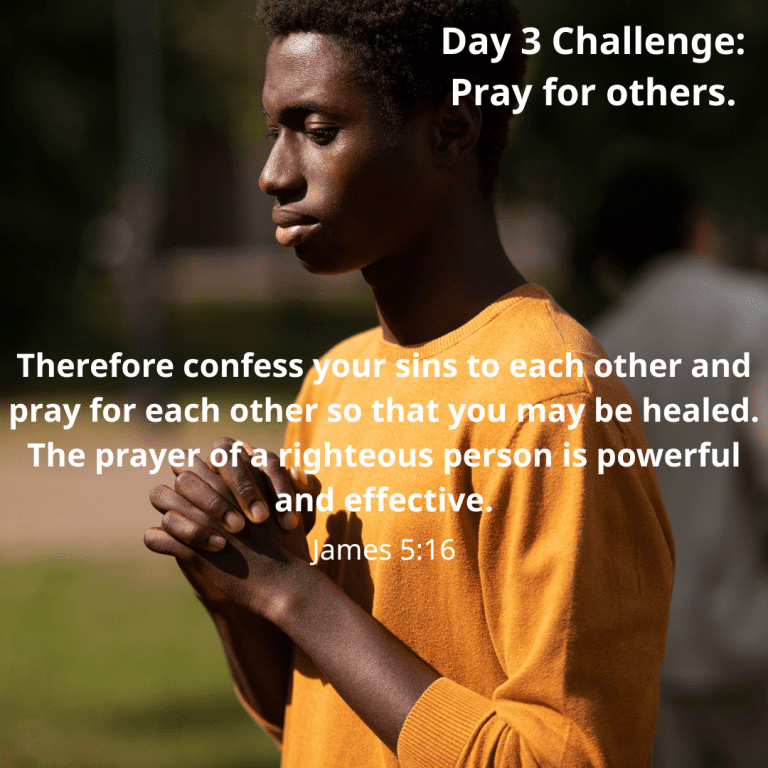
James 5:16 – “Therefore confess your sins to each other and pray for each other so that you may be healed. The prayer of a righteous person is powerful and effective.’”
Prayer is a powerful act of love! Today, let’s take time to lift others up in prayer.
Ways to Pray for Others Today:
Make a list of people to pray for and take time to intercede.
Ask a friend, “How can I pray for you today?”
Pray for your church, leaders, and community.
Let someone know you prayed for them today!
Prayer changes things!
Acts of Kindness Challenge
We would love to hear your story
Prayer is a vital aspect of the Christian faith, serving as a direct line of communication with God. The Bible offers numerous verses that can guide and inspire us in our prayer life. Here are seven Bible verses that can help you to pray:
1. Matthew 6:9-13
“This, then, is how you should pray: ‘Our Father in heaven, hallowed be your name, your kingdom come, your will be done, on earth as it is in heaven. Give us today our daily bread. And forgive us our debts, as we also have forgiven our debtors. And lead us not into temptation, but deliver us from the evil one.’”
The Lord’s Prayer, provides a perfect model for prayer. It includes elements of praise, submission to God’s will, requests for daily needs, forgiveness, and guidance. Using this structure can help us cover all aspects of our spiritual life in prayer.
2. Philippians 4:6
“Do not be anxious about anything, but in every situation, by prayer and petition, with thanksgiving, present your requests to God.”
You are encouraged to turn your worries into prayers. This verse emphasizes importance of approaching God with your needs and anxieties, coupled with a heart of gratitude. This verse reminds you that prayer is a means to relieve anxiety and to trust in God’s provision.
3. 1 Thessalonians 5:16
“Rejoice always, pray continually, give thanks in all circumstances; for this is God’s will for you in Christ Jesus.”
Praying continually doesn’t mean being on our knees all day but maintaining a constant awareness of God’s presence and turning to Him throughout our day. It encourages an attitude of gratitude and joy in all circumstances.
4. James 5:16
“Therefore confess your sins to each other and pray for each other so that you may be healed. The prayer of a righteous person is powerful and effective.”
James 5:16 emphasizes the power of communal prayer and confession. It encourages us to support each other through prayer and to recognize the importance of a righteous person’s prayer. You are encouraged to seek out prayer partners and to be diligent in your intercessions for others.
5. Romans 8:26
“In the same way, the Spirit helps us in our weakness. We do not know what we ought to pray for, but the Spirit himself intercedes for us through wordless groans.”
You can find comfort in knowing that the Holy Spirit assists you in your prayers, especially when you are uncertain about what to pray for. The Spirit’s intercession ensures that your prayers align with God’s will, providing a deeper connection in your communication with God.
6. Matthew 7:7-8
“Ask and it will be given to you; seek and you will find; knock and the door will be opened to you. For everyone who asks receives; the one who seeks finds; and to the one who knocks, the door will be opened.”
Jesus assures you that your earnest seeking and asking will not go unanswered. This promise can bolster your confidence in approaching God with your needs and desires, knowing that He listens and responds.
7. 1 John 5:14-15
“This is the confidence we have in approaching God: that if we ask anything according to his will, he hears us. And if we know that he hears us—whatever we ask—we know that we have what we asked of him.”
God is attentive to your prayers. It highlights the importance of aligning your requests with His will, giving you confidence that your prayers are heard and will be answered in accordance with His divine plan.
Conclusion
Prayer is a powerful and essential practice in the Christian life. These seven Bible verses offer guidance, encouragement, and assurance in our prayer journey. By meditating on and incorporating these scriptures into your prayer life, you can deepen your relationship with God, approach Him with confidence, and experience the transformative power of prayer.
Prayer is a vital aspect of the Christian faith, serving as a direct line of communication with God. The Bible offers numerous verses that can guide and inspire us in our prayer life. Here are seven Bible verses that can help you to pray:
1. Matthew 6:9-13
“This, then, is how you should pray: ‘Our Father in heaven, hallowed be your name, your kingdom come, your will be done, on earth as it is in heaven. Give us today our daily bread. And forgive us our debts, as we also have forgiven our debtors. And lead us not into temptation, but deliver us from the evil one.’”
The Lord’s Prayer, provides a perfect model for prayer. It includes elements of praise, submission to God’s will, requests for daily needs, forgiveness, and guidance. Using this structure can help us cover all aspects of our spiritual life in prayer.
2. Philippians 4:6
“Do not be anxious about anything, but in every situation, by prayer and petition, with thanksgiving, present your requests to God.”
You are encouraged to turn your worries into prayers. This verse emphasizes importance of approaching God with your needs and anxieties, coupled with a heart of gratitude. This verse reminds you that prayer is a means to relieve anxiety and to trust in God’s provision.
3. 1 Thessalonians 5:16
“Rejoice always, pray continually, give thanks in all circumstances; for this is God’s will for you in Christ Jesus.”
Praying continually doesn’t mean being on our knees all day but maintaining a constant awareness of God’s presence and turning to Him throughout our day. It encourages an attitude of gratitude and joy in all circumstances.
4. James 5:16
“Therefore confess your sins to each other and pray for each other so that you may be healed. The prayer of a righteous person is powerful and effective.”
James 5:16 emphasizes the power of communal prayer and confession. It encourages us to support each other through prayer and to recognize the importance of a righteous person’s prayer. You are encouraged to seek out prayer partners and to be diligent in your intercessions for others.
5. Romans 8:26
“In the same way, the Spirit helps us in our weakness. We do not know what we ought to pray for, but the Spirit himself intercedes for us through wordless groans.”
You can find comfort in knowing that the Holy Spirit assists you in your prayers, especially when you are uncertain about what to pray for. The Spirit’s intercession ensures that your prayers align with God’s will, providing a deeper connection in your communication with God.
6. Matthew 7:7-8
“Ask and it will be given to you; seek and you will find; knock and the door will be opened to you. For everyone who asks receives; the one who seeks finds; and to the one who knocks, the door will be opened.”
Jesus assures you that your earnest seeking and asking will not go unanswered. This promise can bolster your confidence in approaching God with your needs and desires, knowing that He listens and responds.
7. 1 John 5:14-15
“This is the confidence we have in approaching God: that if we ask anything according to his will, he hears us. And if we know that he hears us—whatever we ask—we know that we have what we asked of him.”
God is attentive to your prayers. It highlights the importance of aligning your requests with His will, giving you confidence that your prayers are heard and will be answered in accordance with His divine plan.
Conclusion
Prayer is a powerful and essential practice in the Christian life. These seven Bible verses offer guidance, encouragement, and assurance in our prayer journey. By meditating on and incorporating these scriptures into your prayer life, you can deepen your relationship with God, approach Him with confidence, and experience the transformative power of prayer.

James 5:7-12 Be patient, therefore, brothers, until the coming of the Lord. See how the farmer waits for the precious fruit of the earth, being patient about it, until it receives the early and the late rains. You also, be patient. Establish your hearts, for the coming of the Lord is at hand. Do not grumble against one another, brothers, so that you may not be judged; behold, the Judge is standing at the door. As an example of suffering and patience, brothers, take the prophets who spoke in the name of the Lord. Behold, we consider those blessed who remained steadfast. You have heard of the steadfastness of Job, and you have seen the purpose of the Lord, how the Lord is compassionate and merciful. But above all, my brothers, do not swear, either by heaven or by earth or by any other oath, but let your “yes” be yes and your “no” be no, so that you may not fall under condemnation.
The Epistle of James is filled with practical guidance on issues like controlling the tongue, caring for others, and being patient in trials.
James’s emphasis on wisdom and practical action is still relevant today, reminding us that our faith should impact everyday life, not just what we believe.
Question: How does your faith impact your daily actions? What wisdom from James’s teachings could help you in your personal challenges?
James: Writer of Practical Wisdom
The Epistle of James is filled with practical guidance on issues like controlling the tongue, caring for others, and being patient in trials.
The Epistle of James is filled with practical guidance on issues like controlling the tongue, caring for others, and being patient in trials.
Day 3: Pray for Others
Prayer is a powerful act of love! Today, let’s take time to lift others up in prayer.
7 Bible verses to help you pray
Prayer is a powerful and essential practice in the Christian life. These seven Bible verses offer guidance, encouragement, and assurance in our prayer journey. By meditating on and incorporating these scriptures into your prayer life, you can deepen your relationship with God, approach Him with confidence, and experience the transformative power of prayer.
Prayer is a powerful act of love! Today, let’s take time to lift others up in prayer.
Prayer is a powerful and essential practice in the Christian life. These seven Bible verses offer guidance, encouragement, and assurance in our prayer journey. By meditating on and incorporating these scriptures into your prayer life, you can deepen your relationship with God, approach Him with confidence, and experience the transformative power of prayer.
Prayer is a powerful and essential practice in the Christian life. These seven Bible verses offer guidance, encouragement, and assurance in our prayer journey. By meditating on and incorporating these scriptures into your prayer life, you can deepen your relationship with God, approach Him with confidence, and experience the transformative power of prayer.