

Can You Follow Christ Without Losing Your African Identity?
If you are a young African today, especially Gen Z, you may sometimes feel pulled between faith and culture.
You love God.
You respect your heritage.
You value your language, family systems, music, and traditions.
But maybe you have wondered:
“Do I have to become someone else to truly follow Christ?”
Some voices online suggest Christianity belongs to a certain culture or lifestyle. Others make African identity feel incompatible with faith.
But here is the truth:
Following Jesus Christ does not require you to stop being African. God never asks you to erase who He created you to be, He transforms it for His purpose.
Long before modern history shaped how Christianity was presented in many places, God was already working among nations, languages, and cultures across Africa and beyond.
Let’s walk through 7 Bible truths speaking directly to you, your identity, your struggles, and your future.
1. You Were Created With Purpose — Including Your Culture
Genesis 1:27
“So God created mankind in his own image, in the image of God he created them; male and female he created them.”
You were not randomly born into your culture.
Your skin.
Your language.
Your family systems.
Your storytelling traditions.
God saw all of it before you were born.
If God created humanity in His image, then your identity matters to Him.
You don’t have to imitate another culture to be accepted by God.
When you follow Christ, you are not becoming less African, you are becoming more aligned with God’s design.
2. God Wants You to Hear Him in Your Own Language
Acts 2:6
“When they heard this sound, a crowd came together in bewilderment, because each one heard their own language being spoken.”
On the day of Pentecost, God could have chosen one “holy language.”
He didn’t.
People heard the message of God in their own tongues.
Imagine that moment.
No translation confusion.
No cultural superiority.
God met people where they were.
If you speak Shona, Sesotho, Madinka, Swahili, or any African language, God honours that.
You do not need to abandon your voice or accent for God to speak to you.
3. God Looks at Your Heart — Not Your Appearance
1 Samuel 16:7
“But the Lord said to Samuel, ‘Do not consider his appearance or his height, for I have rejected him. The Lord does not look at the things people look at. People look at the outward appearance, but the Lord looks at the heart.’”
Social media pressures you to look a certain way.
Dress a certain way.
Speak a certain way.
Even worship a certain way.
But God evaluates differently.
He is not impressed by imitation.
He is moved by sincerity.
African worship expressions, singing loudly, dancing, storytelling, joyful praise, can deeply honour God when they come from the heart.
Authentic faith is not copying trends. It is loving God honestly.
4. Your Community Values Reflect God’s Wisdom
Ecclesiastes 4:9–10
“Two are better than one, because they have a good return for their labour: If either of them falls down, one can help the other up. But pity anyone who falls and has no one to help them up.”
Many African cultures emphasise community.
Family helps family.
Neighbours support neighbours.
Extended relatives matter.
Sometimes modern culture calls this “old-fashioned.”
But Scripture calls it wisdom.
God never designed you to struggle alone.
Supporting each other is not weakness, it is biblical strength.
5. You Can Honour Tradition Without Following Everything
Exodus 20:12
“Honour your father and your mother, so that you may live long in the land the Lord your God is giving you.”
You may face moments where faith and certain expectations clash.
Maybe family traditions conflict with your beliefs.
God commands honour, not blind obedience.
Honour means respect, kindness, and humility.
But following Christ may sometimes mean choosing what is right even when it is difficult.
You can respect your elders and still walk faithfully with God.
6. God Cares About Nations — Including Yours
Psalm 33:12
“Blessed is the nation whose God is the Lord, the people he chose for his inheritance.”
Your country matters to God.
Your community matters.
Africa’s history includes resilience, creativity, and hope.
Many young Africans today are:
- entrepreneurs,
- creatives,
- digital evangelists,
- innovators.
Your faith can shape your workplace, your neighbourhood, and your nation.
Christianity is not an escape from Africa.
It is a calling to transform it.
7. Heaven Celebrates Diversity — Forever
Revelation 7:9
“After this I looked, and there before me was a great multitude that no one could count, from every nation, tribe, people and language, standing before the throne and before the Lamb. They were wearing white robes and were holding palm branches in their hands.”
Look carefully at heaven.
Not one tribe.
Not one culture.
Every nation.
Every language.
God’s final vision is unity without erasing identity.
That includes you.
Your language.
Your heritage.
Your story.
You were never asked to become someone else to belong to God’s family.
A Message Directly to You
You don’t have to choose between loving Christ and loving your African identity.
Follow Christ fully.
Let Him challenge harmful practices.
Let Him heal broken traditions.
Let Him refine culture with truth and love.
But never believe the lie that faith requires you to abandon who you are.
God knew exactly where you would be born.
And He still called you.
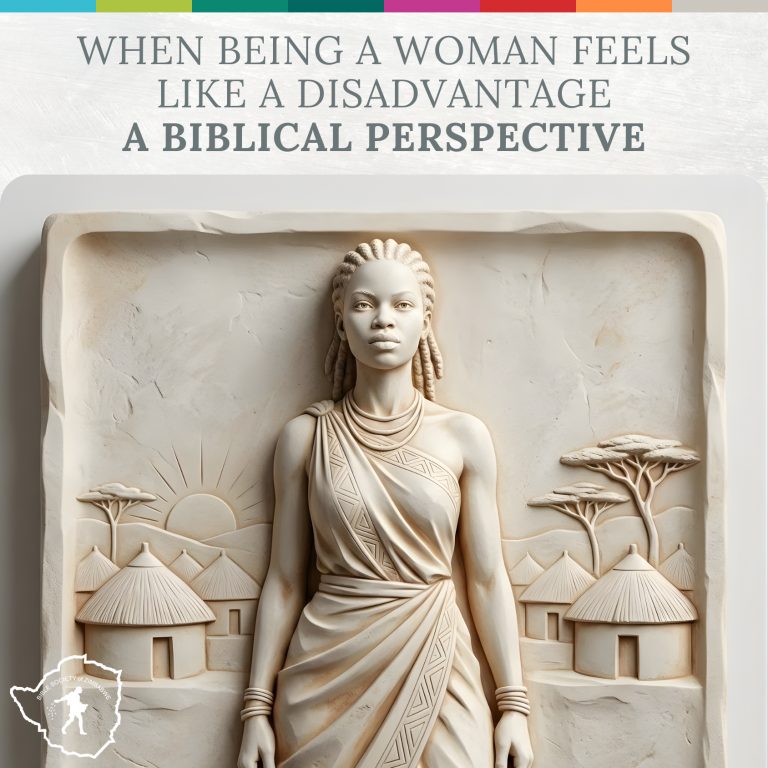
Many women, especially young women, quietly wrestle with this thought:
“Is being a woman a disadvantage?”
It can feel that way when:
- your voice is overlooked
- your abilities are doubted
- your safety feels fragile
- your value is reduced to appearance
- your timeline is controlled by social pressure
- your sacrifices go unnoticed
But Scripture tells a very different story. From the beginning, God established women with dignity, authority, purpose, and spiritual strength. Let’s walk through 7 Bible verses that speak directly to seasons when being a woman feels like a disadvantage.
1. Genesis 1:27 — Your Value Was Established at Creation
“So God created mankind in his own image, in the image of God he created them; male and female he created them.” (NIV)
Before society formed opinions about women, God formed identity. Both male and female were created in His image, equal in worth, equal in dignity, equal in spiritual value.
This means your value is not cultural, it is created. Not negotiated, declared. When the world minimizes women, creation itself speaks otherwise.
2. Judges 4:4–5 — God Raises Women Leaders
“Now Deborah, a prophet, the wife of Lappidoth, was leading Israel at that time.” (NIV)
Deborah was not hidden. She was not secondary. She was a national leader, judge, and prophet.
When leadership spaces feel closed to women, Deborah’s story reminds us: God is not limited by human bias. He appoints based on calling, not gender expectations.
Your leadership is not a mistake. Your voice is not out of place.
3. Psalm 139:14 — You Are Not a Design Error
“I praise you because I am fearfully and wonderfully made.” (NIV)
When being a woman feels like a burden instead of a blessing, this verse calls you back to truth: you are not an afterthought. Not an inferior version. Not a weaker model.
You are intentional design.
Your emotions, intuition, resilience, and nurturing strength are not flaws, they are features.
4. Luke 8:1–3 — Jesus Publicly Valued Women
“…the Twelve were with him, and also some women… These women were helping to support them out of their own means.” (NIV)
In a culture where women were often excluded, Jesus welcomed them into His mission circle. He taught them, traveled with them, and honored their contributions.
Jesus did not treat women as background characters, but as partners in purpose.
If you ever feel spiritually sidelined, remember: Jesus pulled women closer, not further away.
5. Proverbs 31:25 — Strength Is Feminine Too
“She is clothed with strength and dignity; she can laugh at the days to come.” (NIV)
Biblical womanhood is not a weakness. It is strength with dignity.
This woman is not fearful of the future, she faces it with confidence. Not because life is easy, but because her foundation is secure.
Strength is not unfeminine. Strength is biblical.
6. Galatians 3:28 — Your Spiritual Standing Is Equal
“There is neither Jew nor Gentile, neither slave nor free, nor is there male and female, for you are all one in Christ Jesus.” (NIV)
Before God, your access, inheritance, and spiritual identity are not limited by gender.
You are not spiritually second-class. Not spiritually delayed. Not spiritually restricted.
In Christ, you stand fully included.
7. John 20:16–18 — A Woman First Carried the Resurrection Message
Jesus said to her, “Mary.” … Mary Magdalene went to the disciples with the news: “I have seen the Lord!” (NIV)
The first recorded witness and messenger of the resurrection was a woman.
At the most important announcement in history, Jesus chose a woman to carry the news.
When the world questions whether women should speak, lead, or proclaim truth, the resurrection story answers clearly.
Final Encouragement: When It Feels Hard to Be a Woman
Yes, challenges women face are real. Inequality, pressure, vulnerability, and misunderstanding exist. But disadvantage is not destiny.
Biblically:
- Women are image-bearers
- Leaders
- Witnesses
- Supporters of mission
- Carriers of strength
- Voices of truth
- Chosen messengers
When being a woman feels like a disadvantage, remember, in God’s story, women are never optional. They are essential.

Marriage is the foundation for the Christian family. Husband and wife and by God’s grace blessed with children. Whether you hope to marry one day or are already married it’s good to go to the Bible and learn about marriage.
- Genesis 2:24 Therefore a man shall leave his father and his mother and hold fast to his wife, and they shall become one flesh.
Marriage is mentioned already in creation. Whether you are already married or not, here are Bible verses to guide you to what the Bible says about marriage.
- 1 Corinthians 7:2 But because of the temptation to sexual immorality, each man should have his own wife and each woman her own husband.
There are many kinds of temptations in the world. To be married is to give our love and loyalty to our husband or wife.
- Ephesians 5:25 Husbands, love your wives, as Christ loved the church and gave himself up for her
In a Christian marriage the husband is to love his wife as Christ loved us. This is to love even when it’s not deserved, unconditionally.
- Colossians 3:18-19 Wives, submit to your husbands, as is fitting in the Lord. Husbands, love your wives, and do not be harsh with them.
Love between husband and wife includes for the husband to be gentle and giving himself up for his wife, and for the wife to submit to and respect her husband.
- Exodus 20:14 You shall not commit adultery.
Loyalty and trust are fundamental in all relationships. In marriage that means to forsake all others and not have any other intimate relationships.
- Matthew 5:27-28 You have heard that it was said, ‘You shall not commit adultery.’ But I say to you that everyone who looks at a woman with lustful intent has already committed adultery with her in his heart.
Jesus taught us that it’s not only the act of adultery that is breaking the commandment, but even lustful thoughts.
- Ephesians 4:32 Be kind to one another, tenderhearted, forgiving one another, as God in Christ forgave you.
Although this verse speaks of the love between all Christians, it also applies to husband and wife. Forgive each other and be kind.

How does the Bible view women? At face value, some of its messages and examples can seem oppressive or devaluing. But when you learn more about how Jesus responded to the Bible’s historical and cultural context, you may rethink your first impressions. Christ entered into a specific time and culture that had assumptions very different from ours. How can understanding the biblical context inform our reading? How can the context help us to better understand who Jesus is—what he values, loves, and expects of his followers? Take a look, traveling all the way back to the culture Jesus entered.
How the Greeks Viewed Women
Let’s begin with the philosophers. Writers and thinkers often infuse a culture with certain beliefs—and this was especially so in the Greco-Roman world. When examined closely, some of their ideas may seem surprisingly antiquated to the modern reader.
For example, the revered philosopher Plato believed that women should be confined to the home while men tended to the business of state and commerce. Aristotle went even further, teaching that women were inferior to men, incapable of abstract thought, and emotionally volatile. Thus husbands and fathers were to rule over their wives and daughters. This thinking reflects the basic attitude toward women during the classical period.
How did these attitudes affect a woman’s life? The picture is not a pretty one. A young Greek girl is routinely married off to an older man. Her husband is free to take a concubine, and romantic love is not expected within marriage. Her role is to bear and raise children and run the household. She will rarely leave the house. Her education is limited to learning domestic tasks. She is not permitted to vote or hold property. Why would she be? As Euripides the playwright notes, “A woman is handicapped by intellect.” Thucydides helps him along by writing, “The name of a decent woman, like her person, should be shut up in the house.”
How the Jews Viewed Women
By Jesus’s time Greek ideas—including these ideas about women—had gradually crept into Jewish culture, despite Old Testament writings to the contrary. In the creation account in Genesis, God creates human beings as both male and female, giving them co-equal stewardship over the earth (Genesis 1:26-30). Throughout the Old Testament, women are given equal access to God’s law and held equally responsible to keep it.
The Old Testament record is replete with women whose great courage often surpasses that of the men around them. The stories of Miriam, Rahab, Ruth, Deborah, Hannah, Abigail, and Esther are prime examples of women whose insight and fortitude greatly influence the biblical narrative and the way God’s people understood themselves.
The Jewish understanding of women was so affected by exile, conquest, and trade that by Jesus’s time women were discouraged from studying Torah, God’s law, and encouraged to stay home to fulfill household duties. They attended synagogue assemblies seated separately from the men. The Greek-educated Jewish philosopher Philo, a contemporary of Jesus, saw women as having weak judgment and considered them unfit to learn the law. Some rabbis even went so far as to encourage men to limit their conversations with their own wives. What was the point of talking to someone with little knowledge of the law?
How Jesus Viewed Women
Into this distortion of God’s original intent for women comes a new teacher, the rabbi called Jesus of Nazareth. What do we know about Jesus’s relationships with women? Did he hold the same opinions as his culture? Let’s take a look at a few of his encounters with women.
Jesus speaks to a Samaritan woman in public (John 4:4-30)
Jesus shocks the woman at the well by asking her for a drink. Thus he steamrolls over cultural taboos against men speaking to women as well as Jewish prejudice against Samaritans. “You are a Jew and I am a Samaritan woman. How can you ask me for a drink?”
Jesus then reveals himself to her as the Messiah and the giver of the living water for which she longs.
Jesus teaches a woman one-on-one (Luke 10:38-42)
Women were not expected to study Torah, yet this renegade rabbi singles out one woman and opens Scripture to her. Mary “sat down at the feet of the Lord and listened to his teaching.” This position was that of the traditional rabbinic student.
When her sister complains about needing help, Jesus tells her that “Mary has chosen what is better, and it will not be taken away from her.”
Jesus comforts a widow and confronts death (Luke 7:11-17)
“Don’t cry,” Jesus says to a grieving widow whose son lies dead in his coffin. He touches the coffin, defying ceremonial law. Jaws drop in amazement as the young man sits up and begins to speak. Jesus gives the widow’s son back to her, alive and well.
Jesus touches an “unclean” woman (Luke 8:43-48)
Ceremonially unclean due to a chronic hemorrhage, a woman touches the hem of Jesus’ cloak. “Daughter,” Jesus speaks tenderly. “Your faith has healed you. Shalom.”
Jesus touches an infirm woman (Luke 13:10-16)
The religious leaders object to Jesus’s laying his healing hands on a crippled woman on the Sabbath.
“You hypocrites!” Jesus does not mince words. “Any one of you would untie your ox or your donkey from the stall and take it out to give it water on the Sabbath.Now here is this descendant of Abraham whom Satan has kept in bonds for eighteen years; should she not be released on the Sabbath?”
Jesus deals with a woman caught in adultery (John 8:1-11)
The woman’s accusers are silenced by Jesus’s words, “Whichever one of you has committed no sin may throw the first stone at her.” But he is gentle in his conversation with her.
Jesus allows Mary to anoint him (John 12:1-8)
When people are horrified at Mary’s extravagant outpouring of love, Jesus silences them all. Rather than rebuking her for touching him in this intimate way, he lavishes high praise on her. “Leave her alone; she’s anointing me for burial. This story will be told wherever the Gospel is preached.”
Jesus appears first to a woman after his Resurrection (John 20:11-18)
Although women were considered to be unreliable witnesses in court, Jesus assigns Mary Magdalene the task of being the first witness to the Resurrection.
Scripture’s Good News for Women
So what did Jesus really think of women? Did he touch them? Did he talk with them? Did he teach them? Did he give equal moral standing with men? Did he value them?
The record speaks for itself. First-century women in Palestine were second-class citizens. Sadly, some church leaders have still viewed and treated women in this way. But Jesus turned the tables on his culture, and his example calls us to do the same. Again and again, Jesus affirmed women’s value and dignity.
As the apostle Paul affirms in Galatians 3:26-28 (NIV): “So in Christ Jesus you are all children of God through faith, for all of you who were baptized into Christ have clothed yourselves with Christ. There is neither Jew nor Gentile, neither slave nor free, nor is there male and female, for you are all one in Christ Jesus.”