
Who wrote the Pentateuch?
The first five books of the Bible — and one of history’s oldest open questions. Was it Moses, writing as an eyewitness? Scribes in Babylon, centuries later? Or something in between? The debate has run for centuries, and the evidence cuts both ways.
Who Wrote the Bible? — Series 1
From Genesis to Deuteronomy — the debate that’s been running for centuries.
First things first: what even is the Pentateuch?
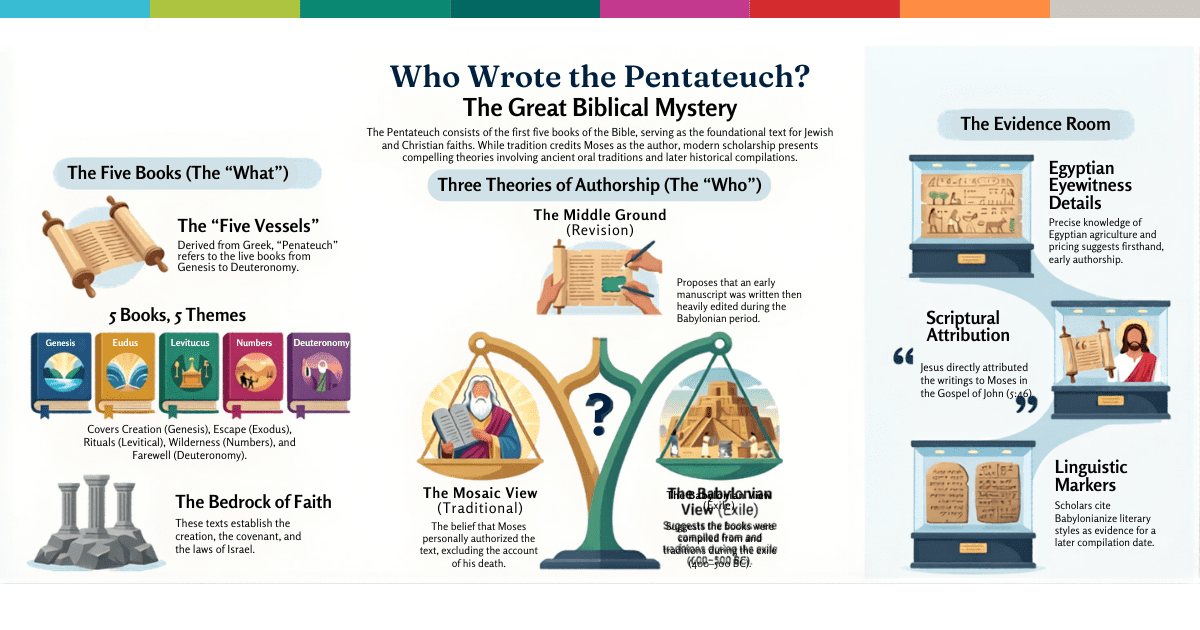
If you’ve never heard this word before, no stress — it sounds intimidating but it’s actually straightforward. Penta is Greek for “five,” and teuchos means “vessel” or “book.” So the Pentateuch is simply the first five books of the Bible.
Genesis Exodus Leviticus Numbers Deuteronomy. Click on the plus sign to expand knowledge +
In the beginning
→ Genesis ~ origins of everything. Creation, the fall, Noah, Abraham, Joseph. The family tree of a nation begins here.
The great escape
→ Exodus ~ Moses, the plagues, the Red Sea, Sinai. A people walks out of slavery into a covenant with God.
Laws and rituals
→ Exodus ~ Moses, the plagues, the Red Sea, Sinai. A people walks out of slavery into a covenant with God.
40 years in the desert
→ Numbers ~ forty years of wandering. Censuses, rebellions, and a generation that dies in the wilderness.
Laws and rituals
→ Deuteronomy ~ Moses’ farewell speech. One last recap of the law before Israel crosses into the Promised Land.
Together, these five books lay the foundation for everything that follows in the Bible — creation, the fall, the covenant with Abraham, the Exodus from Egypt, and the laws given to Israel. Big stuff.
So who wrote the Pentateuch?
Here’s where it gets interesting. This is one of the oldest debates in Biblical scholarship, and scholars are still going back and forth on it. There are three main camps:
VIEW 01 ·
TRADITIONAL
Moses wrote it.
The traditional view. Moses authored the Pentateuch — except the last few verses of Deuteronomy, which describe his own death. (Obviously.)
VIEW 02 ·
CRITICAL
Written in Babylon.
Some scholars say it was compiled during the Babylonian exile, around 600–500 BC, weaving together several older oral traditions.
VIEW 03 ·
MIDDLE GROUND
Written early, edited later.
Some scholars say it was compiled during the Babylonian exile, around 600–500 BC, weaving together several older oral traditions.
What’s the evidence?
Each side has its receipts. Those who argue for a Babylonian origin point to certain features of the language and literary style that, they say, match that later period. The counter-argument? The Pentateuch contains surprisingly precise knowledge of Egyptian agricultural calendars and pricing — detail that reads like an eyewitness account, not a story reconstructed centuries later from a distance.
And then, of course, there’s what the Bible itself actually says about the matter.
Exodus 34:27 · ESV
“And the Lord said to Moses, ‘Write these words, for in accordance with these words I have made a covenant with you and with Israel.'”
John 5:46 · ESV
“For if you believed Moses, you would believe me; for he wrote of me.”
That second one is Jesus speaking — and he’s directly attributing the writings to Moses. For many believers, that settles it. For others, it opens up a whole new set of questions about how to read and interpret the Bible. Either way, it’s not a debate that’s going away anytime soon.
The bottom line
Whoever put pen to papyrus (or stylus to clay), the Pentateuch is the bedrock of both the Jewish and Christian faiths — and the gateway to understanding the rest of the Bible. Whether you’re reading it as ancient history, divine revelation, or literary tradition, the questions it raises are worth sitting with.
What’s your take?
Did Moses write it, or is it more complicated than that?
More from this series